Migraine Market Size in the 7MM is projected to grow at a significant CAGR over the forecast period of 2026-2036 | DelveInsight
(Albany, US), October 19, 2026 – DelveInsight’s ‘Migraine Market Insights, Epidemiology and Market Forecast – 2036’ report delivers an in-depth understanding of Migraine, historical and forecasted epidemiology, as well as the Migraine market trends in the United States, EU4 (Germany, Spain, Italy, and France), the United Kingdom, and Japan.
Explore the intricate details of the Migraine Market Report @ Migraine Treatment Market Size
Key Takeaways from the Migraine Market Report
-
In June 2026, Kallyope presented findings from multiple clinical and preclinical studies supporting the initiation of Phase III trials of elismetrep. The data were presented at the American Headache Society (AHS) 68th Annual Scientific Meeting.
-
In April 2026, the company presented results from a Phase IIb dose-ranging and proof-of-concept study of elismetrep. The findings were shared during an oral presentation titled “TRPM8 Antagonism with Elismetrep: A Novel Approach for Treating Migraine” at the 2026 American Academy of Neurology (AAN) Annual Meeting.
-
In June 2026, Lundbeck announced the presentation of new data on eptinezumab-jjmr (VYEPTI) at the American Headache Society (AHS) 68th Annual Scientific Meeting in Orlando, Florida. The presentations included findings from the INFUSE, DELIVER, SUNSET, and RESOLUTION trials, highlighting real-world evidence and post-hoc analyses of Phase III clinical trial data. The studies evaluated patient-reported outcomes related to headache hours, brain fog, other cognitive symptoms, and dose escalation.
-
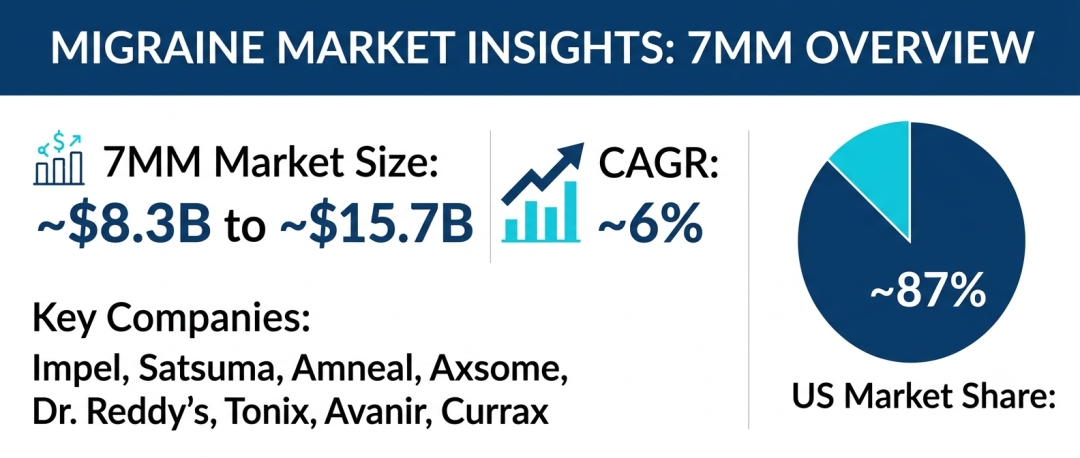
According to DelveInsight’s analysis, the Migraine market size was found to be ~USD 8,300 million in the 7MM in 2025 and is projected to reach ~USD 15,700 million by 2036, growing at a CAGR of ~6% during 2026-2036.
-
The United States accounted for the highest market size of Migraine, approximately 87% (~USD 7,100 million) of the total market size in the 7MM in 2025.
-
Migraine represents a substantial epidemiological burden across the 7MM, with adults accounting for 85 million prevalent cases in 2025, compared with 7 million cases in the pediatric population.
-
Migraine diagnosis is standardized through ICHD-3 clinical criteria but remains largely dependent on symptom history rather than an objective biomarker, creating challenges in atypical or first-time presentations and in distinguishing migraine, particularly aura, from neurological mimics such as transient ischemic attack.
-
Prevention has rapidly shifted toward CGRP-targeted therapies, but inconsistent responses leave many patients with limited alternatives, keeping the market highly concentrated around CGRP-based treatment options.
-
The discontinuation of Lasmiditan (REYVOW) in the US in 2026 highlights the commercial challenges of differentiated acute therapies, underscoring that mechanistic novelty alone may not be sufficient to drive market uptake.
-
Reimbursement restrictions, patient affordability, and treatment access can limit uptake of higher-priced CGRP mAbs and gepants, creating a persistent gap between clinical availability and real-world utilization.
-
The leading Migraine Companies include Impel NeuroPharma, Satsuma Pharmaceuticals, Amneal Pharmaceuticals, Axsome Therapeutics, Dr. Reddy’s Laboratories, Tonix Pharmaceuticals, Avanir Pharmaceuticals, Currax Pharmaceuticals, and others.
-
Promising Migraine Therapies include Dihydroergotamine mesylate (TRUDHESA), Meloxicam + Rizatriptan (SYMBRAVO), Sumatriptan Succinate (ZEMBRACE SYMTOUCH), Sumatriptan (TOSYMRA), Elismetrep (K-304), Dysport (abobotulinumtoxinA), Xeomin (incobotulinumtoxinA), EVO756, and others.
Get a Free sample for the Migraine Market Forecast, Size & Share Analysis Report @ Migraine Therapeutics Market
Migraine Overview
Migraine is a common, disabling neurological disorder characterized by recurrent attacks of moderate-to-severe headache, often accompanied by symptoms such as nausea, vomiting, and sensitivity to light and sound. Migraine can occur with or without aura, with migraine without aura being the more common presentation. Attacks typically last several hours to a few days and can substantially affect daily activities, work productivity, and quality of life. Diagnosis is primarily clinical and is based on the patient’s medical history, symptom pattern, headache characteristics, and neurological examination. There is no single laboratory test or imaging procedure that confirms migraine. Clinicians generally assess the frequency, duration, location, and intensity of headaches, associated symptoms, presence of aura, and potential triggers while ruling out other causes of headache. Neuroimaging or additional investigations may be considered when patients present with atypical symptoms, abnormal neurological findings, or warning signs suggestive of a secondary headache disorder.
Migraine Epidemiology Segmentation in the 7MM
-
Migraine Prevalent Cases
-
Migraine Prevalent Cases by Gender
-
Acute and Chronic Migraine Prevalent Cases
-
Menstrual Migraine Prevalent Cases
-
Migraine Prevalent Cases by Severity (MIDAS Grading)
-
Chronic/Episodic Migraine Receiving Treatments
-
Chronic/Episodic Migraine Receiving Preventive Treatments
Download the report to understand which factors are driving Migraine Epidemiology trends @ Migraine Prevalence
Migraine Epidemiology Key Findings
-
Migraine prevalence in Japan is relatively low compared with the overall 7MM burden. In 2025, Japan accounted for approximately 10.1% of the total migraine prevalent cases across the 7MM.
-
Migraine prevalence is consistently higher among women than men, largely associated with hormonal and biological factors, particularly fluctuations in estrogen during the menstrual cycle. Approximately 30–70% of female migraineurs report attacks during the perimenstrual period.
-
In the United States, the acute migraine severity distribution in 2025 was estimated at 16 million, 7 million, 8 million, and 14 million for MIDAS Grade I, Grade II, Grade III, and Grade IV, respectively.
-
Despite the high prevalence of migraine in the United States, treatment uptake remains relatively low, with only around half of patients seeking or receiving treatment.
-
Among EU4 and the UK countries, Italy reported the highest acute treatment pool, whereas France had the lowest.
-
Among EU4 and the UK countries, Germany reported the highest chronic treatment pool, whereas Spain had the lowest.
Approved Therapies for Migraine
-
Dihydroergotamine mesylate (TRUDHESA): Impel NeuroPharma
Dihydroergotamine mesylate (TRUDHESA) nasal spray (0.725 mg per spray) is approved by the US FDA for the acute treatment of migraine with or without aura in adults. Using Impel’s proprietary Precision Olfactory Delivery (POD) Technology, TRUDHESA delivers Dihydroergotamine mesylate (DHE) quickly to the bloodstream through the vascular-rich upper nasal space. In September 2021, Impel NeuroPharma announced that the US FDA approved TRUDHESA for acute migraine with or without aura in adults.
-
Dihydroergotamine mesylate (BREKIYA): Amneal Pharmaceuticals
BREKIYA provides a novel, patient-friendly approach for the rapid and effective treatment of acute migraine and cluster headaches, improving access to care outside hospital settings. It allows patients to self-administer a single subcutaneous dose into the mid-thigh. In May 2025, the US FDA approved BREKIYA injection for the acute treatment of migraine with or without aura and cluster headaches in adults, and in October 2025, Amneal Pharmaceuticals announced its US commercial launch as the first and only ready-to-use DHE autoinjector.
Migraine Pipeline Analysis
-
Elismetrep (K-304): Kallyope
Elismetrep (K-304) is an investigational, novel, oral, Transient Receptor Potential Melastatin 8 (TRPM8) migraine-associated channel blocker (MACB) that is highly selective for TRPM8 migraine-associated channels vs. other TRP channels. Specifically designed to block TRPM8 activity, elismetrep has been shown to reduce migraine pain and associated symptoms. It is currently in Phase III. In June 2026, Kallyope presented results from several clinical and preclinical studies that support the initiation of Phase III studies of elismetrep at the American Headache Society 68th Annual Scientific Meeting.
-
Dysport (abobotulinumtoxinA): Ipsen
Dysport (abobotulinumtoxinA) is an injectable form of a botulinum neurotoxin type A (BoNT-A) product, derived from Clostridium bacteria, that inhibits the effective transmission of nerve impulses and thereby reduces muscular contractions. It is supplied as a lyophilized powder and is in Phase III for episodic and chronic migraine with or without aura.
Discover more about therapies set to grab Major Migraine Market Share @ Migraine Market Drivers and Barriers
Migraine Market Outlook
Historically, acute migraine management relied heavily on non-specific analgesics and NSAIDs, including ibuprofen, naproxen, diclofenac, and acetylsalicylic acid. Triptans, beginning with sumatriptan (IMITREX) in 1992, subsequently became the leading migraine-specific acute treatment class. More recently, CGRP-targeted gepants, including ubrogepant, rimegepant, and zavegepant, have expanded acute treatment options, while atogepant has broadened the use of CGRP-targeted therapies into acute and preventive management. For migraine prevention, treatment has evolved from traditional agents toward more targeted therapies, with CGRP monoclonal antibodies, including erenumab, fremanezumab, galcanezumab, and eptinezumab, expanding preventive treatment for episodic and chronic migraine. The market size in the 7MM will increase at a CAGR of 6% due to increasing awareness of the disease, better diagnosis, and the launch of emerging therapies. The current emerging migraine landscape is largely dominated by preventive therapies, including next-generation botulinum toxin approaches such as Dysport and Xeomin, alongside novel candidates such as EVO756 and bocunebart (AG09222), while elismetrep (K-304) is among the key late-stage candidates in acute treatment.
Migraine Treatment Landscape
Migraine treatment is generally divided into acute (abortive) therapy to relieve ongoing attacks and preventive therapy to reduce attack frequency, severity, and associated disability. Acute treatment commonly includes NSAIDs, acetaminophen, triptans, and newer CGRP-targeted agents, while preventive treatment includes CGRP monoclonal antibodies, oral gepants, onabotulinumtoxinA for chronic migraine, and traditional agents such as beta-blockers, antiepileptics, and antidepressants. Treatment selection depends on attack frequency, severity, comorbidities, treatment response, and patient preference. Key factors driving the market include the increasing migraine burden and unmet treatment needs, advances in migraine-specific therapies, and a growing preference for convenient and well-tolerated treatment options.
To know more about Migraine Companies working in the treatment market, visit @ Migraine Market Access and Reimbursement
Scope of the Migraine Market Report
-
Coverage- 7MM
-
Study Period- 2022-2036
-
Forecast Period- 2026-2036
-
Migraine Companies- Impel NeuroPharma, Satsuma Pharmaceuticals, Amneal Pharmaceuticals, Axsome Therapeutics, Dr. Reddy’s Laboratories, Tonix Pharmaceuticals, Avanir Pharmaceuticals, Currax Pharmaceuticals, and others.
-
Migraine Therapies- Dihydroergotamine mesylate (TRUDHESA), Meloxicam + Rizatriptan (SYMBRAVO), Sumatriptan Succinate (ZEMBRACE SYMTOUCH), Sumatriptan (TOSYMRA), Elismetrep (K-304), Dysport (abobotulinumtoxinA), Xeomin (incobotulinumtoxinA), EVO756, and others.
-
Migraine Market Dynamics: Migraine market drivers and market barriers
-
Migraine Competitive Intelligence Analysis: SWOT Analysis, Conjoint Analysis
-
Migraine Unmet Needs, KOL Views, Reimbursement
Table of Contents
-
Key Insights
-
Report Introduction
-
Executive Summary of Migraine
-
Key Events
-
Epidemiology and Market Forecast Methodology
-
Migraine Market Overview at a Glance
-
Disease Background and Overview
-
Current Treatment Practices: Migraine
-
Epidemiology and Patient Population of 7MM
-
Patient Journey
-
Marketed Therapies
-
Emerging Therapies
-
Migraine: The 7MM Analysis
-
Unmet Needs
-
SWOT Analysis
-
KOL Views
-
Market Access and Reimbursement
-
Appendix
-
DelveInsight Capabilities
-
Disclaimer
-
About DelveInsight
Media Contact
Company Name: DelveInsight Business Research LLP
Contact Person: Abhishek kumar
Email: Send Email
Phone: 09650213330
Address:304 S. Jones Blvd #2432
City: Las Vegas
State: NV
Country: United States
Website: https://www.delveinsight.com/sample-request/migraine-market


