Efficiency vs. Cost: Optimizing Processing with a High Quality Vacuum Rake Dryer Solution from Nantong Kneading Machinery
Nantong, Jiangsu, China – November 20, 2026
Drying Heat-Sensitive Materials: Balancing Gentleness and Efficiency
Walk onto any modern pharmaceutical or fine chemical plant floor, and engineers face a familiar dilemma: stripping moisture from temperature-critical cake without destroying compound integrity or inflating utility bills. Thermal batch production requires balancing drying speed with product protection. Traditional atmospheric air systems rely on high temperatures, risking thermal degradation, surface crusting, or color alteration in sensitive active intermediates, dyes, and extracts. Vacuum operation fundamentally shifts this balance by depressing solvent boiling points. The high quality vacuum rake dryer solution from Nantong Kneading Machinery addresses this challenge by combining low-temperature vacuum evaporation with mechanical mass transfer.
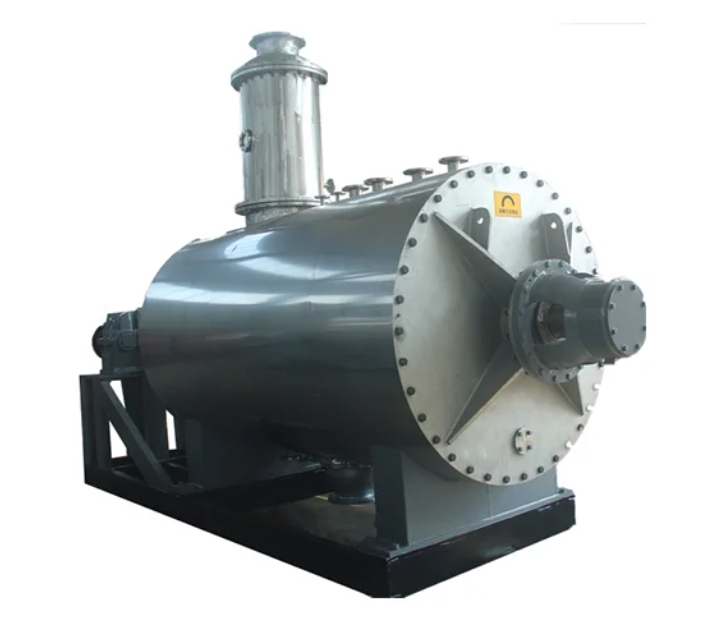
Built around a jacketed horizontal cylinder, the system uses an internal rotating shaft with angled rake teeth turning at 6 to 8 rpm to continuously lift and redistribute material against the heated wall. An integrated scraping action prevents boundary-layer buildup and crusting. By constantly renewing the wet mass contact surface, the high quality vacuum rake dryer maintains uniform heat distribution throughout the batch without localized overheating or thermal stress.
Vacuum Levels and Thermal Energy Efficiency in Industrial Processing
Evaluating the energy profile of industrial drying equipment requires analyzing phase-change thermodynamics rather than relying on generalized power-saving claims. In a standard horizontal batch vessel engineered by Nantong Kneading Mixing Machine Co., Ltd., the vacuum system maintains an absolute vacuum level down to -0.095 MPa (or cylinder operating pressures ranging between -0.09 MPa and 0.15 MPa). Lowering internal vessel pressure depresses the vapor pressure threshold of water and volatile organic solvents. Water, which normally boils at 100°C under standard atmospheric conditions, vaporizes at significantly lower temperatures under a -0.095 MPa vacuum environment.
This thermodynamic shift allows plant operators to substitute high-pressure steam with lower-temperature heating media within the outer jacket, such as hot water, low-pressure saturated steam, or thermal oil operating at reduced temperature setpoints. A segmented temperature control profile further refines thermal management throughout the cycle. High heat input is applied during the initial sensible heating and constant-rate drying phases, followed by controlled thermal reduction during the falling-rate drying stage when internal diffusion dominates moisture movement. Because the thermal gradient required for solvent evaporation is decreased, the total thermal energy input needed per kilogram of evaporated moisture drops accordingly. Continuous vapor extraction through the top vacuum port prevents vapor saturation inside the chamber, sustaining a driving vapor pressure differential that accelerates drying cycles without raising internal product temperature.
Hidden Cost Factors and Operational Dynamics in Batch Drying Cycles
While single-batch thermal energy consumption is a primary engineering metric, total cost efficiency in multi-product chemical and pharmaceutical manufacturing is heavily influenced by non-drying cycle time elements. Intermittent batch processing involves clear sequential phases: charging raw wet cakes or slurries, executing thermal vacuum drying, cooling the vessel, and discharging finished dry powder. In facilities handling short production runs or varied product grades, turn-around times between batches significantly impact daily overall plant output. Nantong Kneading Machinery incorporates specific mechanical design considerations to streamline these transition periods.
The horizontal vessel geometry, paired with reversible or multi-angled rake blades, facilitates clean discharging through the bottom discharge valve assembly. Minimizing dead spaces along the cylinder walls reduces manual intervention during batch discharge and chamber cleaning routines. High-grade mechanical seals and vacuum-tight access hatches allow rapid technical inspection and sampling without compromising seal integrity over extended operation. When evaluating equipment selection, facility managers must consider accessibility for clean-in-place procedures and maintenance turnarounds. Operating a reliable vacuum rake dryer solution that minimizes product hold-up and simplifies cleanout reduces downtime between production campaigns, lowering the labor cost per batch and improving total equipment utilization across multi-grade manufacturing lines.
Operational Matching Criteria for Industrial Dryer Selection
Selecting appropriate thermal processing equipment requires a detailed technical comparison of material physical characteristics rather than relying on a single standardized machine recommendation. The high quality vacuum rake dryer manufactured by Nantong Kneading Mixing Machine Co., Ltd. is specifically engineered for high-viscosity pastes, filter cakes, slurries, crystalline powders, and heat-sensitive thermal masses, but it is not universally superior to alternative industrial drying systems like fluid bed dryers or rotary double-cone vacuum dryers. Determining the proper operational fit involves evaluating four primary process variables: feed initial moisture content, particle morphology, final target moisture levels, and batch volume scale.
Fluidized bed drying requires pumpable or easily dispersible granules capable of suspension in upward air streams, making it less suitable for cohesive pastes or sticky slurries that cause air channeling and bed collapse. Double-cone dryers excel with free-flowing crystalline solids but lack internal mechanical agitation, leading to poor heat conduction in highly viscous materials. The vacuum rake dryer solution fills this operational gap for materials that exhibit high viscosity or lump-forming tendencies during liquid removal. Continuous mechanical shearing from the internal rake assembly breaks down agglomerates during phase transition, enabling even heat penetration throughout the mass. Models ranging in volume from 500 liters up to 15,000 liters allow processing parameters to be matched directly to plant production volumes, balancing heat transfer surface area with jacket heating medium flow rates.
Process Boundaries and Operational Performance Standards
Defining the economic and technical boundaries of batch vacuum drying relies on matching material physical behavior to fundamental heat transfer mechanisms. The high quality vacuum rake dryer solution delivers consistent, repeatable results when processing industrial materials that demand low-temperature moisture removal, enclosed dust containment, and active mechanical turnover. Engineers and technical specialists at Nantong Kneading Machinery continue to refine vessel geometries, shaft sealing systems, and agitation dynamics to serve chemical, dye, pharmaceutical, and polymer industries.
By aligning vessel pressure control, jacket temperature profiles, and mechanical rake designs with specific material characteristics, industrial processors can achieve predictable drying times while protecting product quality and controlling long-term operating costs. Detailed technical specifications, vessel dimension options, and material suitability assessments for specific industrial processing requirements are available on the official company website.
To review equipment parameters, vessel capacity options, and application case studies, visit https://www.globalkneaders.com/
About Us
Nantong Kneading Mixing Machine Co., Ltd is a science & technology enterprise focusing on design, manufacture, sales and service. The strict management, excellent service and brave innovation created the first-class product quality.
Our company founded in 1992, we have 30 years experience in producing various of equipment. We can produce 70 kinds of machines such as kneader, internal mixer, mixer, dryer, cellulose CMC special complete sets of equipment, alcohol recovery tower and condenser . Our company covers an area of 30 acres, we are a national high-tech enterprises with import and export business.
Our company has first-class technology and a stable customer base,we have established a long-term research partnership with Nantong University and South China University of Technology and we own more than 10 national patents.Our company have 125 employees, including 10 high, intermediate professional and technical personnel who have rich experience in research and development, manufacturing capacity. The annual production capacity have reached 500 units .
We have rich experience in design and manufacture, strong technical force, sophisticated processing and testing equipment and complete quality system.we have passed ISO9001 quality system certification and European CE certification.We enforce safety standardization strictly. Our company is a standard level three enterprise of machinery Industry.
Media Contact
Company Name: Nantong Kneading Mixing Machine Co.,Ltd
Contact Person: Media Relations
Email: Send Email
Country: China
Website: https://www.globalkneaders.com/com


