Food Allergy Market to Reach Nearly USD 10,500 Million by 2036, Growing at ~9% CAGR | DelveInsight
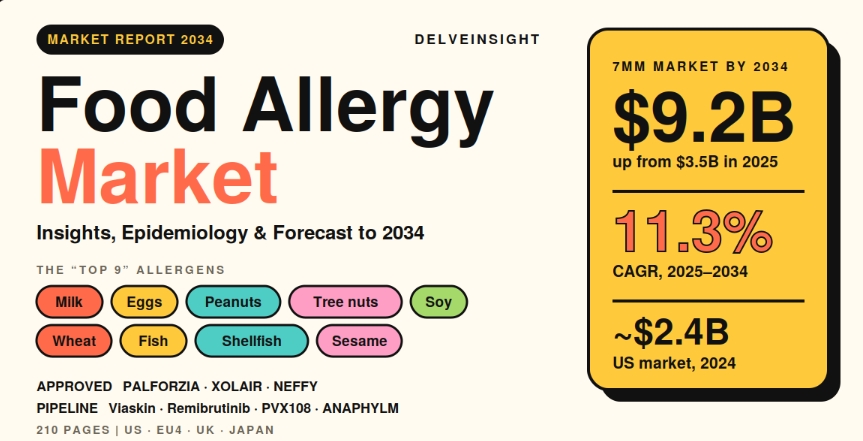
The report analyzes the current treatment landscape, standards of care and evolving therapeutic algorithms, as well as patient burden trends, revenue and market share dynamics, peak patient share and therapy uptake. It also highlights key unmet medical needs and maps the competitive and clinical landscape to uncover high-value opportunities.
Get a free sample of the Food Allergy Market Forecast
Key Facts from the Food Allergy Market Report
-
The Food Allergy market in the 7MM was valued at approximately USD 3,500 million in 2025 and is projected to reach nearly USD 10,500 million by 2036, at a CAGR of about 9% (2026–2036).
-
The United States is the largest market. Among the EU4 and the UK, Germany held the largest share in 2025, followed by the UK, while France held the smallest.
-
The 7MM had approximately 61 million diagnosed prevalent cases of Food Allergy in 2025, with males accounting for 53% and females 47%.
-
Approved medications include omalizumab (XOLAIR), epinephrine nasal spray (NEFFY/EURNEFFY) and peanut allergen powder (PALFORZIA). Stallergenes Greer discontinued PALFORZIA commercialization as of July 31, 2026, a decision it said was not related to safety, quality or efficacy.
-
February 2026: Aquestive Therapeutics announced it received a Complete Response Letter (CRL) from the FDA on January 30, 2026, for its NDA for ANAPHYLM (dibutepinephrine) Sublingual Film for Type I allergic reactions, including anaphylaxis, in patients weighing 30 kg or more.
-
February 2026: Per Novartis’ Q4 2025 presentation, a Phase III program for remibrutinib is anticipated to start in the second half of 2026.
-
August 2025: Stallergenes Greer announced the voluntary discontinuation of PALFORZIA by July 31, 2026, not due to safety, quality or efficacy concerns.
-
Epinephrine is the first-line treatment for anaphylaxis, and antihistamines, corticosteroids and bronchodilators serve only as adjunctive therapies.
-
Late-stage candidates include DBV Technologies’ Viaskin Peanut Patch (DBV712), Aravax’s PVX108 (AVX-201) and Aquestive Therapeutics’ ANAPHYLM (epinephrine sublingual film).
To know more about the Food Allergy market outlook, drug uptake, treatment scenario and epidemiology trends, click here: https://www.delveinsight.com/report-store/food-allergy-market-insights
Food Allergy Overview
Food allergy is an immune-mediated condition in which the body mistakenly identifies certain food proteins as harmful. Symptoms range from itching, hives, swelling, abdominal pain, vomiting and diarrhea to anaphylaxis, which can involve difficulty breathing and a drop in blood pressure and can be life-threatening. Common allergens include peanuts, tree nuts, milk, eggs, wheat, soy, fish and shellfish. The condition typically develops from a combination of genetic and environmental factors, and much of the burden is linked to comorbid atopic conditions such as asthma, atopic dermatitis and allergic rhinitis.
Food Allergy Market Diagnosis
Diagnosis relies mainly on clinical evaluation and a detailed history of reproducible symptoms after food exposure. Skin prick testing and serum-specific IgE measurements help confirm sensitization, and the oral food challenge remains the gold standard for definitive diagnosis.
Food Allergy Market Treatment Landscape
Treatment aims to prevent reactions, reduce the risk of anaphylaxis, improve quality of life and, where possible, induce long-term immune tolerance. Management centers on strict allergen avoidance and patient education, with epinephrine as first-line emergency treatment. Immunotherapy is increasingly used in a step-wise manner, including oral immunotherapy (OIT), with epicutaneous (EPIT) and sublingual (SLIT) approaches emerging as alternatives with improved safety profiles. For severe or multiple food allergies, biologics such as XOLAIR may be considered.
Discover the current and emerging Food Allergy treatment landscape
Food Allergy Epidemiology Highlights
-
The 7MM had approximately 61 million diagnosed prevalent cases in 2025.
-
Among the EU4 and the UK, Spain had the most diagnosed prevalent cases, followed by Germany, and France had the fewest.
-
Males accounted for 53% of cases and females 47%.
-
In Japan, egg allergy had the highest diagnosed prevalence among food allergens, followed by milk allergy, with fish allergy the lowest.
The epidemiology chapter covers total, allergen-specific, gender-specific and severity-specific diagnosed prevalent cases, as well as total treated cases.
Download the report to understand which factors are driving Food Allergy epidemiology trends
Key Food Allergy Market Drivers
-
Rising prevalence: About 61 million diagnosed prevalent cases in the 7MM in 2025.
-
Targeted therapies: Emerging evidence of improved safety, tolerability and potential disease-modifying effects of novel immunotherapies is creating opportunities for approaches that induce immune tolerance and long-term protection.
-
Evolving pipeline: Candidates such as DBV712, PVX108 and ANAPHYLM are advancing through clinical trials.
Food Allergy Marketed Therapies
Omalizumab (XOLAIR) – Novartis/Roche: A monoclonal anti-IgE antibody that binds free IgE and prevents it from interacting with receptors on mast cells and basophils. It received US FDA approval in 2024 to reduce the risk of allergic reactions, including anaphylaxis, after accidental exposure to one or more foods. It is also approved in Europe (2024) and Japan (2025).
Epinephrine nasal spray (NEFFY/EURNEFFY) – ARS Pharmaceuticals, ALK-Abelló and Alfresa Pharma: A needle-free, intranasal epinephrine for the emergency treatment of allergic reactions, including anaphylaxis. It is approved in the US and Europe and offers a user-friendly alternative to auto-injectors.
Peanut allergen powder-dnfp (PALFORZIA) – Stallergenes Greer: An oral immunotherapy approved in the US and Europe in 2020. The company discontinued commercialization effective July 31, 2026.
Food Allergy Emerging Therapies
Viaskin Peanut Patch (DBV712) – DBV Technologies: An epicutaneous immunotherapy that delivers small, controlled amounts of peanut protein through the skin to promote immune tolerance with minimal systemic exposure. It is in Phase III for peanut allergy.
PVX108 (AVX-201) – Aravax: An investigational peptide-based immunotherapy that targets T-cell epitopes of peanut allergens using short synthetic peptides that do not cross-link IgE. It is in Phase III for peanut allergy.
ANAPHYLM (dibutepinephrine) sublingual film – Aquestive Therapeutics: A sublingual epinephrine film for anaphylaxis, in Phase II per the report’s pipeline table.
Learn more about the companies and therapies set to grab major Food Allergy market share
Food Allergy Market Recent Developments
-
February 2026: Aquestive Therapeutics announced it received a Complete Response Letter (CRL) from the FDA on January 30, 2026, for its NDA for ANAPHYLM (dibutepinephrine) Sublingual Film for Type I allergic reactions, including anaphylaxis, in patients weighing 30 kg or more.
-
February 2026: Per Novartis’ Q4 2025 presentation, a Phase III program for remibrutinib is anticipated to start in the second half of 2026.
-
August 2025: Stallergenes Greer announced the voluntary discontinuation of PALFORZIA by July 31, 2026, not due to safety, quality or efficacy concerns.
Food Allergy Market Unmet Needs
-
Lack of curative therapies, with current management relying on avoidance
-
Risk of severe reactions (anaphylaxis) and unpredictable triggers
-
Limitations in diagnostic accuracy and standardization
Food Allergy Market Outlook
The market is shifting from strict allergen avoidance and emergency management toward proactive, disease-modifying approaches that aim for long-term tolerance rather than temporary desensitization. The US is the largest market, supported by higher awareness, improved diagnosis rates, strong regulatory support and early adoption of novel therapies. Better diagnostic practices, rising awareness among patients and caregivers, and differentiated therapies are expected to drive steady growth through the forecast period.
Scope of the Food Allergy Market Report
-
Study period: 2022–2036 (historical 2022–2025; forecast 2026–2036; base year 2026)
-
Geographies: US, EU4 (Germany, France, Italy, Spain), UK and Japan
-
Segmentation: by region and by therapy
-
Analysis: KOL views, SWOT, reimbursement, conjoint analysis, unmet needs, market drivers and barriers
-
Methodology: epidemiology-based, bottom-up forecasting; AI-enabled report with 11-year forecast
About DelveInsight
DelveInsight is a leading healthcare business consultant and market research firm focused exclusively on life sciences. It supports pharma companies with comprehensive end-to-end solutions to improve their performance, and offers healthcare consulting services that help accelerate business growth and overcome challenges with a practical approach.
Media Contact
Company Name: DelveInsight Business Research LLP
Contact Person: Mehul Malhotra
Email: Send Email
Phone: 09650213330
Address:63, M3M 113 Market, Sector 113 NV 89107
City: Gurugram
State: IN – Indiana
Country: India
Website: https://www.delveinsight.com/consulting


