Carcinoembryonic Antigen Market to Reach USD 3.12 Billion by 2031 as Colorectal Cancer Monitoring and High-Sensitivity Immunoassays Drive Growth
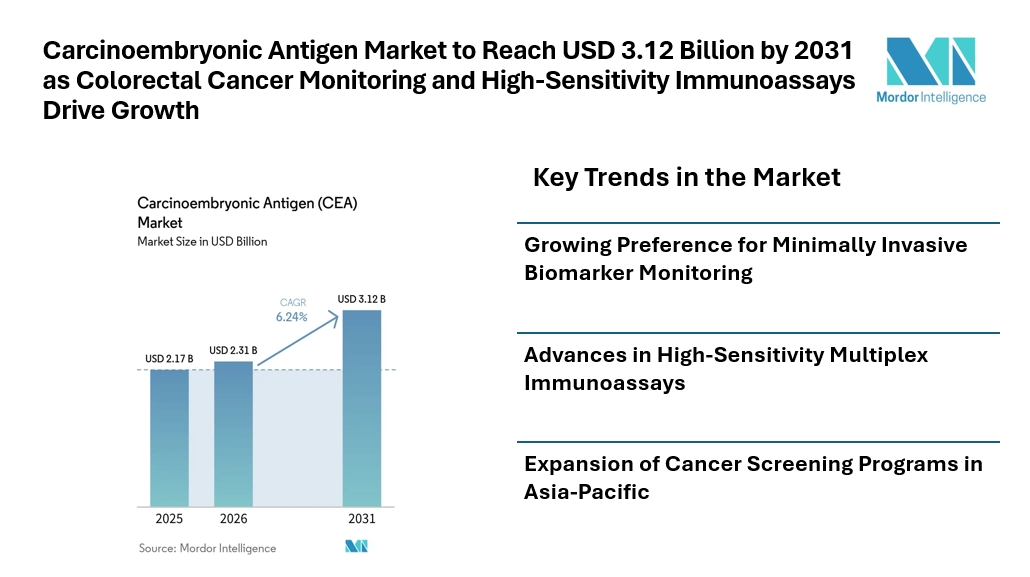
India, Hyderabad – 8th october 2026, According to Mordor Intelligence, the Carcinoembryonic Antigen (CEA) Market size is estimated at USD 2.31 billion in 2026 and is expected to reach USD 3.12 billion by 2031, registering a CAGR of 6.24% during the forecast period. North America currently holds the largest market share, while Asia-Pacific is projected to register the fastest growth.
Carcinoembryonic antigen is a blood-based tumor marker used primarily to monitor certain cancers, particularly colorectal cancer. CEA testing is used across hospitals, diagnostic laboratories, and research institutions, with demand supported by rising colorectal cancer incidence, increasing use of minimally invasive biomarker monitoring, improvements in high-sensitivity immunoassays, and government-supported cancer screening initiatives.
Report Overview: https://www.mordorintelligence.com/industry-reports/carcinoembryonic-antigen-market?utm_source=abnewswire
Carcinoembryonic Antigen Market Trends
Rising Colorectal Cancer Burden Supports CEA Testing
The increasing incidence of colorectal cancer is a major factor supporting the Carcinoembryonic Antigen Market growth. CEA measurement is widely used during the follow-up of patients who have undergone treatment for colorectal cancer, particularly for monitoring disease progression or recurrence.
The growing cancer burden across both developed and emerging economies is increasing the number of patients requiring regular biomarker monitoring. As healthcare systems strengthen cancer diagnosis and follow-up pathways, recurring CEA testing is expected to remain an important source of demand for assay kits, reagents, and laboratory services.
Growing Preference for Minimally Invasive Biomarker Monitoring
Blood-based testing is gaining importance as healthcare providers seek monitoring approaches that reduce procedural burden for patients. CEA testing can be performed through routine blood collection, making it suitable for repeated monitoring during cancer treatment and follow-up.
The use of serial CEA measurements in post-treatment surveillance is also supporting recurring testing volumes. Increasing interest in combining CEA with other biomarkers and diagnostic technologies is further expanding its role within broader cancer-monitoring workflows.
Advances in High-Sensitivity Multiplex Immunoassays
Technological improvements in immunoassay platforms are expanding the capabilities of CEA testing. High-sensitivity systems can analyze multiple oncology-related biomarkers in a single workflow, allowing laboratories to obtain broader clinical information from limited patient samples.
Multiplex testing is also encouraging laboratories to combine CEA with markers such as CA19-9, AFP, and NSE. Automation and higher testing throughput are improving laboratory efficiency, while integrated analyzer and assay platforms are helping manufacturers strengthen their position in the Carcinoembryonic Antigen industry.
Expansion of Cancer Screening Programs in Asia-Pacific
Government-supported cancer screening programs are creating additional opportunities for the Carcinoembryonic Antigen Market across Asia-Pacific. China, Japan, and other countries in the region are strengthening cancer prevention and screening initiatives, increasing demand for diagnostic tests and laboratory infrastructure.
The expansion of centralized procurement and public healthcare programs is also supporting demand for assay kits and analyzers. Growing healthcare investment in India and other emerging economies is expected to further increase access to oncology diagnostics and expand testing volumes.
Limited Specificity Creates Challenges for CEA Testing
Despite its established role in cancer monitoring, CEA has limited specificity because elevated levels can also occur in certain non-malignant conditions. This reduces its suitability as a standalone population-screening tool and can result in additional diagnostic investigations.
Competition from circulating tumor DNA, proteomic platforms, and other emerging biomarkers is another challenge. These technologies can provide additional molecular information and may increasingly complement or replace conventional single-marker testing in selected clinical applications.
Carcinoembryonic Antigen Market Segmentation
By Product
-
Assay Kits: Represent the leading product segment, supported by their established use across hospitals, diagnostic laboratories, and other testing environments.
-
Analyzers / Instruments: Include automated platforms used to process CEA assays and support higher laboratory throughput.
-
Consumables & Reagents: This segment is expected to grow rapidly as increasing testing volumes drive recurring demand for laboratory consumables.
By Application
-
Colorectal Cancer: The leading application, supported by the established use of CEA for treatment monitoring and disease surveillance.
-
Pancreatic Cancer
-
Lung Cancer
-
Breast Cancer
-
Liver Cancer: Expected to record strong growth as CEA is increasingly incorporated into broader oncology monitoring approaches.
-
Others
By End User
-
Hospitals & Surgical Centers: The largest end-user segment, supported by the integration of CEA testing into oncology and peri-operative care pathways.
-
Diagnostic Laboratories: Expected to record strong growth as centralized laboratories expand high-throughput testing capabilities.
-
Academic & Research Institutes
-
Others
By Geography
-
North America: United States, Canada, and Mexico
-
Europe: Germany, United Kingdom, France, Italy, Spain, and Rest of Europe
-
Asia-Pacific: China, India, Japan, South Korea, Australia, and Rest of Asia-Pacific
-
South America: Brazil, Argentina, and Rest of South America
-
Middle East and Africa: GCC, South Africa, and Rest of Middle East and Africa
Carcinoembryonic Antigen Market Competitive Landscape
The Carcinoembryonic Antigen Market share is moderately concentrated, with major diagnostic companies competing through assay portfolios, automated analyzers, laboratory automation, companion diagnostics, and advanced testing platforms. Established companies are also forming partnerships and expanding their diagnostic capabilities to respond to demand for faster and more integrated testing workflows.
Key Players
-
F. Hoffmann-La Roche Ltd
-
Abbott Laboratories
-
Thermo Fisher Scientific Inc.
-
Siemens Healthineers AG
-
Danaher Corporation
-
Becton, Dickinson and Company
-
bioMérieux SA
-
DiaSorin S.p.A.
-
Merck KGaA
-
Bio-Rad Laboratories, Inc.
-
Tosoh Corporation
-
Fujirebio Diagnostics
-
Sysmex Corporation
-
Randox Laboratories Ltd.
-
Quanterix Corporation
-
Creative Diagnostics
-
LabCorp
-
Quest Diagnostics Incorporated
Companies are focusing on automated laboratory workflows, high-sensitivity assays, multiplex testing, point-of-care formats, and artificial intelligence-supported diagnostics to strengthen their positions in the Carcinoembryonic Antigen industry.
For more insights on the Japanese market report, please visit the Mordor Intelligence page: https://www.mordorintelligence.com/ja/industry-reports/carcinoembryonic-antigen-market?utm_source=abnewswire
Conclusion
The Carcinoembryonic Antigen Market forecast points to steady expansion as colorectal cancer monitoring remains a core application and healthcare providers increasingly adopt minimally invasive biomarker testing. Improvements in high-sensitivity immunoassays, laboratory automation, and multiplex testing are creating additional opportunities for diagnostic manufacturers.
North America is expected to retain its leading position due to established oncology infrastructure, reimbursement support, and widespread use of CEA testing. Meanwhile, Asia-Pacific is projected to experience the fastest growth as cancer screening programs expand, diagnostic infrastructure improves, and healthcare systems increase access to biomarker-based testing.
About Mordor Intelligence
Mordor Intelligence is a global market intelligence firm, founded in 2014, helping businesses make informed decisions through data-driven insights, industry expertise, and advanced analytics. With 550+ domain experts and on-ground specialists across 150+ countries, the company delivers comprehensive intelligence across aerospace & defense, agriculture, automation, automotive, chemicals & materials, consumer goods & services, electronics, energy & power, financial services, food & beverages, healthcare, hospitality & tourism, information & communications technology, and logistics.
Its offerings include syndicated industry reports and subscription platforms such as Synapse. Mordor Intelligence is ISO 9001:2015 and ISO/IEC 27001:2022 certified, a member of ESOMAR and the Market Research Society of India, and a four-time Great Place to Work® honoree. Learn more at mordorintelligence.com.
Media Contact
Company Name: Mordor Intelligence Private Limited
Contact Person: Jignesh Thakkar
Email: Send Email
Phone: +1 617-765-2493
Address:11th Floor, Rajapushpa Summit, Nanakramguda Rd, Financial District, Gachibowli
City: Hyderabad
State: Telangana 500008
Country: India
Website: https://www.mordorintelligence.com/


