BSP vs. NPT Threads in Irrigation: Key Differences for Reliable Sprinkler Connections
Ningbo City, Zhejiang Province, China-September 22, 2026
TL;DR — what to remember
- BSP and NPT share nominal inch sizes (1/2″, 3/4″, 1″, etc.) but have different thread angles: BSP uses 55 degrees, NPT uses 60 degrees. They are not interchangeable.
- BSP is the standard across Europe, the United Kingdom, Australia, India, most of Africa, most of Southeast Asia, and mainland China. NPT is the standard across the United States, Canada, Japan, South Korea, and Taiwan.
- The two standards seal differently: BSP relies on a tapered or parallel thread plus a sealing ring (often an O-ring, bonded washer, or PTFE tape); NPT relies on the thread taper itself deforming to create a metal-to-metal seal.
- Mixing a male BSP into a female NPT, or vice versa, will appear to engage for one or two turns and then either jam or leak — the joint cannot be made leak-tight without a converter.
- The Rainling 3/4″ male to 1/2″ female thread adapter is available in both BSP and NPT thread forms; buyers must specify the destination market thread standard at the RFQ stage.
- For OEM buyers shipping irrigation kits to multiple regions, the safest approach is to stock a small inventory of thread adapters and fittings in both standards and to confirm thread specs with our team before bulk production runs.
A 3/4 inch brass sprinkler and a 1/2 inch polyethylene lateral pipe can look identical on the shelf, but if the threads on each end do not match, the joint will either drip continuously, crack under pressure, or refuse to seal at all. The mismatch is not a manufacturer defect — it is the gap between two parallel thread standards that have coexisted in irrigation hardware for more than a century. BSP (British Standard Pipe) and NPT (National Pipe Taper) share the same nominal diameter designations in inches, but they have different thread angles, different thread depths, different sealing geometries, and they are not interchangeable without an adapter. For an irrigation distributor or OEM buyer sourcing thread adapters and fittings for export markets — and pairing them with the broader irrigation product catalog and the pop-up sprinkler range that uses these same thread forms — the wrong thread choice is the single most common cause of warranty returns on sprinkler and drip lateral kits. This guide explains the mechanical difference between BSP and NPT threads, the geographic distribution of each standard, the failure modes when the two are mixed, and how to specify a 3/4 inch male to 1/2 inch female thread adapter correctly for each destination market.
Why two thread standards coexist in irrigation
The history of pipe threads in irrigation reflects the history of industrial pipe threads more broadly. The British Standard Pipe thread family was formalized in the early twentieth century for the British Empire and its trading partners, and was subsequently adopted across Europe, Commonwealth countries, and most of Asia. The American National Pipe Taper thread was formalized by the American National Standards Institute for the United States and Canada, and was adopted by Japan, South Korea, and Taiwan in the postwar industrial expansion. China adopted BSP (specifically G-thread and R-thread variants) as its domestic irrigation thread standard, with metric thread forms playing a secondary role in larger pipe sizes.
The practical consequence for an irrigation OEM is that the same nominal pipe size — say 3/4 inch — exists in two thread geometries, both manufactured in Chinese factories, both commonly shipped in the same container, and both labelled “3/4 inch” on the carton. A buyer in Germany, the United Kingdom, Australia, or the United Arab Emirates will receive the BSP part and expect it to seal on the first installation. A buyer in the United States, Japan, or Taiwan will receive the NPT part and expect the same. A buyer in Mexico, Brazil, or the Philippines may receive either, depending on the distributor’s inventory origin. The irrigation thread standards reference catalog maintained by Rainling Irrigation covers the full range of BSP and NPT fittings in 1/2 inch, 3/4 inch, 1 inch, and larger nominal sizes.
BSP vs NPT thread geometry — the four physical differences
The two thread standards differ in four measurable ways. Each of these differences contributes to the leak or jam that occurs when the two are mixed. The table below summarizes the four key parameters.
| Parameter | BSP (British Standard Pipe) | NPT (National Pipe Taper) | | — | — | — | | Thread angle | 55 degrees (Whitworth form) | 60 degrees | | Thread crest and root | Rounded (Whitworth form) | Flat, truncated | | Thread form | Available in parallel (BSPP / G) and tapered (BSPT / R) variants | Always tapered | | Sealing mechanism | Tapered form (R/Rc) uses thread taper; parallel form (G) requires an O-ring, bonded washer, or PTFE tape | Thread taper itself, with PTFE tape or thread sealant as the standard sealing aid |
The rounded crest and root of the BSP thread, combined with the 55 degree angle, gives the BSP thread a slightly larger pitch diameter for any given nominal size than the NPT thread. The NPT thread’s flat truncated crest and 60 degree angle gives it a smaller pitch diameter. When a male BSP is threaded into a female NPT, the male pitch diameter is larger than the female thread’s pitch diameter — the threads bind before the joint is fully engaged. When a male NPT is threaded into a female BSP, the male pitch diameter is smaller than the female thread’s pitch diameter — the joint engages but leaves helical spiral gaps that cannot be sealed with PTFE tape alone.
BSP variants — G, R, and Rp
BSP is itself a family of three thread forms, and the irrigation industry uses all three. G is the parallel thread form, designated by ISO 228, and is the standard for most modern Irrigation Valves, filters, and manifolds because it allows the seal to be made by an O-ring or bonded washer rather than by thread deformation. R is the external tapered thread form, and Rc is the internal tapered thread form, both designated by ISO 7. R and Rc are commonly used on threaded pipe nipples and hose connectors where the sealing surface is the thread taper itself.
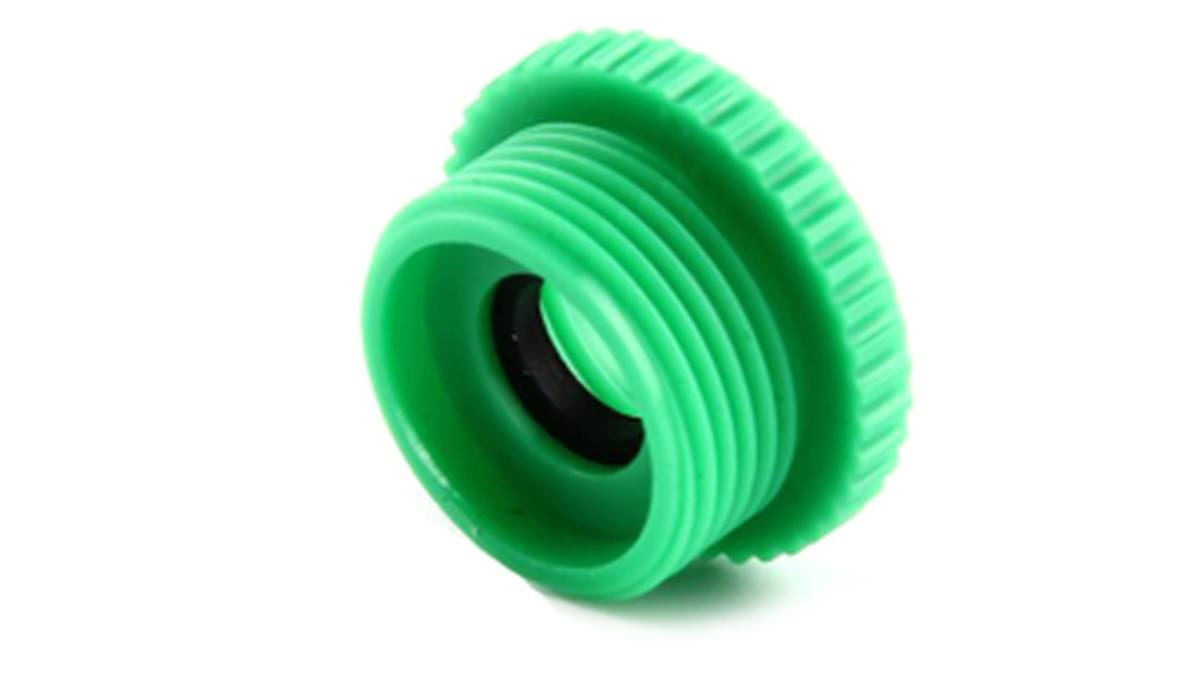
In practice, an irrigation buyer will encounter BSP designations like G1/2, G3/4, G1, R1/2, R3/4, and R1 across sprinkler bodies, valves, and hose connectors. The designation G1/2 means a parallel BSP thread of nominal 1/2 inch size; R3/4 means an external tapered BSP thread of nominal 3/4 inch size. Rainling’s irrigation catalog organizes the fittings by these designations, and the product photo in this article shows the 3/4 inch male to 1/2 inch female thread adapter that is one of the most commonly requested transition pieces.
NPT variants — NPT and NPTF
NPT is simpler than BSP in that it has one dominant form: a tapered thread with a 60 degree angle and flat truncated crests. NPTF (National Pipe Taper Fuel) is a variant used in fuel and gas service where a dryseal metal-to-metal joint is required; it is rarely used in irrigation and is not part of standard irrigation hardware. In irrigation contexts, an NPT designation like 3/4 NPT or 1/2 NPT refers to the standard tapered thread form. The Rainling irrigation catalog includes NPT-threaded fittings and adapters for buyers serving the United States, Canadian, Japanese, South Korean, and Taiwanese markets.
Geographic distribution of each thread standard
Buyers sourcing irrigation hardware for export must match the thread standard to the destination market. The geographic distribution below is a generalization — specific irrigation equipment manufacturers in any country may use either standard — but the dominant practice in each region is well established.
BSP-dominant markets
BSP is the dominant irrigation thread standard in the United Kingdom, Ireland, Germany, France, Italy, Spain, the Netherlands, Belgium, the Nordic countries, Poland, the Czech Republic, Hungary, Romania, Greece, Turkey, the United Arab Emirates, Saudi Arabia, Egypt, South Africa, Australia, New Zealand, India, Pakistan, Bangladesh, Sri Lanka, mainland China, Vietnam, Thailand, Malaysia, Indonesia, the Philippines (for newer installations), Kenya, Nigeria, Ghana, and most of Sub-Saharan Africa.
NPT-dominant markets
NPT is the dominant irrigation thread standard in the United States, Canada, Mexico, Japan, South Korea, Taiwan, the Philippines (for legacy installations), and parts of Brazil.
Mixed markets
Several markets have both BSP and NPT equipment in active use, often because of legacy installations from different eras or because of mixing of domestic and imported hardware. Brazil, Mexico, and the Philippines are the most common mixed markets. Buyers sourcing for these markets typically need to inventory both thread standards and supply thread adapters where the two are mixed within a single Irrigation System.
How to read the marking on a sprinkler body or fitting
Most Irrigation Sprinklers, valves, and fittings have the thread standard stamped or moulded into the body. The marking is small but consistent across the industry. Buyers who learn to read the marking can verify the thread standard before installation.
Reading the marking
A marking of “G1/2” or “G 1/2” indicates a parallel BSP thread of nominal 1/2 inch. A marking of “R1/2” or “R 1/2” indicates an external tapered BSP thread of nominal 1/2 inch. A marking of “1/2 NPT” or “1/2-14 NPT” indicates an NPT thread of nominal 1/2 inch with 14 threads per inch. A marking of “3/4 NPT” or “3/4-14 NPT” indicates an NPT thread of nominal 3/4 inch with 14 threads per inch (the threads-per-inch count is part of the NPT marking convention; BSP usually does not print TPI because it is implicit in the size designation).
What the absence of marking means
Some irrigation fittings, particularly low-cost plastic components from smaller manufacturers, do not print a thread designation. In this case the only way to identify the thread is by measurement with a thread gauge or by a thread-identification go/no-go gauge. Rainling maintains an internal thread-identification reference and can confirm thread specs with our team if the buyer is unsure which standard is required for a specific market.
Failure modes when BSP and NPT are mixed
The mechanical consequence of mixing BSP and NPT depends on which way the mismatch is oriented. There are four possible mismatch scenarios, and each produces a different failure mode.
Male BSP into female NPT — the joint will jam
A male BSP thread has a larger pitch diameter than the corresponding female NPT thread at the same nominal size. The first one or two turns of engagement may feel normal, but as the joint is tightened, the male threads bind against the female thread crests before the joint is fully engaged. Forcing the joint risks stripping the female threads, cracking the female fitting (especially in plastic components), or both. The joint cannot be made leak-tight without a thread converter or replacement fitting.
Male NPT into female BSP — the joint will leak
A male NPT thread has a smaller pitch diameter than the corresponding female BSP thread at the same nominal size. The joint will engage fully and may even feel tight, but the helical gaps between the male thread crests and the female thread roots form spiral leak paths that cannot be sealed by PTFE tape or thread sealant alone. The joint will pass water under pressure, often at a slow drip that becomes a steady leak over time as the fitting expands and contracts with thermal cycling.
Male BSP into female BSPT — the standard sealing case
A male BSP tapered thread (R designation) threaded into a female BSPT thread (Rc designation) seals by thread taper deformation, with PTFE tape as the standard sealant. This is the most common sealing joint in European and Asian irrigation hardware.
Male NPT into female NPT — the standard sealing case
A male NPT thread threaded into a female NPT thread seals by thread taper deformation, with PTFE tape or pipe thread sealant as the standard sealant. This is the most common sealing joint in North American and East Asian irrigation hardware.
How to specify a 3/4 inch male to 1/2 inch female thread adapter
The most commonly requested transition piece in the Rainling irrigation catalog is the 3/4″ male to 1/2″ female thread adapter. This adapter bridges a 3/4 inch male outlet (typically a valve or manifold port) to a 1/2 inch female inlet (typically a polyethylene lateral pipe or drip line connector). Buyers specifying this adapter for export markets must specify four parameters at the RFQ stage:
- The thread standard for the 3/4 inch male end — G3/4 (BSP parallel), R3/4 (BSP tapered), or 3/4 NPT.
- The thread standard for the 1/2 inch female end — G1/2 (BSP parallel), Rc1/2 (BSP tapered), or 1/2 NPT.
- The body material — brass (most common), stainless steel (for corrosive water or soil conditions), or reinforced polypropylene (for cost-sensitive drip irrigation kits).
- The seal type — O-ring, bonded washer, or PTFE tape dependent.
For example, a buyer shipping irrigation kits to Germany would typically specify a G3/4 male to G1/2 female BSP parallel thread adapter with an O-ring seal. A buyer shipping the same kit to the United States would specify a 3/4 NPT male to 1/2 NPT female NPT thread adapter with PTFE tape seal. A buyer shipping to a mixed market like Mexico might specify a G3/4 male to 1/2 NPT female adapter, which is a common transition piece for legacy installations that have NPT hardware downstream of a BSP valve. The Rainling parts and accessories catalog covers both single-standard adapters (BSP-BSP and NPT-NPT) and the cross-standard transition pieces that mixed-market buyers need. Buyers working with the Rainling product team on custom adapter configurations can typically expect a 15 to 25 working day lead time for non-stock thread combinations. For new buyers evaluating the broader Rainling company profile, the Rainling about page provides additional context on manufacturing capability and export experience. Buyers planning a multi-zone irrigation system should also review the broader sprinkler system product family before finalizing the BSP or NPT thread specification for each zone.
Material selection for irrigation thread adapters
Thread adapter body material is as important as thread standard for the long-term reliability of an irrigation system. The three dominant body materials are brass, stainless steel, and reinforced polypropylene, each with distinct cost and performance characteristics.
Brass
Brass is the standard body material for irrigation thread adapters in the 1/2 inch to 1 inch nominal size range. It is compatible with both BSP and NPT threads, has good corrosion resistance in potable and recycled water, and is rated for working pressures up to 16 bar (roughly 230 psi) at ambient temperature. Brass is the default choice for most thread adapters and fittings in the Rainling catalog.
Stainless steel
Stainless steel (typically 304 or 316 grade) is the body material of choice for saline water, acidic soil conditions, or applications where the fitting is buried in corrosive soil. 316 stainless steel is rated for chloride-rich environments including coastal irrigation and reclaimed water with high chloride content. Stainless steel adapters are typically 3 to 5 times the cost of equivalent brass adapters.
Reinforced polypropylene
Reinforced polypropylene (PP) is the body material of choice for cost-sensitive drip irrigation kits and for applications where the fitting is disposable after one or two growing seasons. PP adapters are typically half the cost of brass adapters but are rated for lower working pressures (typically up to 6 bar or 90 psi) and have a shorter service life in UV-exposed above-ground installations.
Ordering and confirming thread specs with Rainling
Rainling’s irrigation thread adapters and fittings are stocked in both BSP and NPT variants for the most common nominal sizes (1/2 inch, 3/4 inch, 1 inch). For non-standard sizes or custom thread combinations, Rainling’s engineering team can produce a custom adapter with a 15 to 25 working day lead time. Buyers who are unsure which thread standard is required for their destination market can confirm thread specs with our team by sharing the destination country, the existing hardware specifications, and a sample of the mating fitting if available.
The landscape irrigationproduct line covers residential and commercial landscape Sprinkler Systems, including thepop-up sprinkler range and the rotor sprinkler range that both use the BSP and NPT thread standards discussed in this guide. Buyers evaluating the broader Rainling product catalog should review the irrigation product family and the about us page for company background, manufacturing capability, and export experience. For buyers who need a transition piece between existing NPT and BSP infrastructure, the female thread adapter product line is the primary Rainling solution, and it pairs with the broader thread adapter and fittings catalog for custom configurations.
FAQQ1: Are BSP and NPT threads the same size in inches?
No. Although the nominal inch designations (1/2″, 3/4″, 1″) are identical, the actual thread geometry differs. BSP threads have a 55 degree thread angle with rounded crests; NPT threads have a 60 degree thread angle with flat truncated crests. The pitch diameter for the same nominal size is larger on BSP than on NPT.
Q2: Can a male BSP thread be forced into a female NPT fitting?
No. The first one or two turns may engage, but the BSP pitch diameter is larger than the NPT pitch diameter, so the male thread will bind against the female thread crests before the joint is fully engaged. Forcing the joint risks stripping the female threads or cracking the female fitting. A thread converter adapter is required.
Q3: Can a male NPT thread be used in a female BSP fitting?
It will engage but will not seal reliably. The NPT pitch diameter is smaller than the BSP pitch diameter, leaving helical spiral gaps that PTFE tape or thread sealant cannot bridge. The joint will leak under pressure, especially as the fitting expands and contracts with thermal cycling.
Q4: What is the difference between BSPP (G) and BSPT (R/Rc)?
BSPP (G designation) is a parallel thread form that seals against an O-ring or bonded washer; it does not rely on the thread taper for sealing. BSPT (R for external, Rc for internal) is a tapered thread form that seals by thread taper deformation, with PTFE tape as the standard sealant. Both are legitimate BSP thread forms used in irrigation hardware.
Q5: How do I know which thread standard my existing sprinkler uses?
Look for the marking stamped or moulded into the sprinkler body. Markings like “G1/2”, “G3/4”, “R1/2”, or “R3/4” indicate BSP threads. Markings like “1/2 NPT” or “3/4 NPT” indicate NPT threads. If no marking is visible, measure the threads per inch with a thread gauge — BSP and NPT have different TPI for the same nominal size.
Q6: Why does China use BSP threads instead of NPT?
China adopted the BSP (Whitworth form, 55 degree angle) thread standard for domestic irrigation hardware because of historical alignment with European irrigation equipment standards. Chinese irrigation factories produce BSP fittings as the default, and NPT fittings as a specialty item for export to North American and East Asian markets.
Q7: Can I use PTFE tape on both BSP and NPT joints?
Yes, PTFE tape is appropriate for both BSPT (R/Rc) tapered threads and NPT tapered threads. PTFE tape should not be used on BSPP (G) parallel threads because the seal is made by the O-ring or bonded washer, not by the thread itself; tape on a parallel thread can actually prevent the O-ring from seating properly.
Q8: What is the working pressure rating for a brass 3/4 inch thread adapter?
A brass 3/4 inch BSP or NPT thread adapter is typically rated for 16 bar (230 psi) at ambient temperature. Working pressure derates with temperature; at 80 °C the rating drops to roughly 10 bar (145 psi). For higher pressure or higher temperature service, stainless steel adapters are recommended.
Q9: Does Rainling offer custom thread adapters for non-standard sizes?
Yes. Rainling’s engineering team can produce custom thread adapters for non-standard sizes, custom thread combinations (for example, G3/4 male to 1/2 NPT female), and custom body materials. Custom adapter lead time is typically 15 to 25 working days. Buyers can request a custom adapter quotation through the contact form with the destination market, the existing hardware specifications, and the working pressure and temperature requirements.
Confirm your thread spec with our engineering team
For irrigation OEM and distributor buyers sourcing thread adapters for export markets, our product management team supports BSP vs NPT specification, custom transition piece design, and bulk order thread verification.
Browse thread adapters and fittings · 3/4″ male to 1/2″ female thread adapter · confirm thread specs with our team
Mr. FanProduct Manager, Rainling Irrigation
Mr. Fan specializes in irrigation system solutions and has extensive experience in agricultural watering equipment, Landscape Irrigation, and water-saving technologies. He is committed to helping global customers improve irrigation efficiency with durable and innovative products.
About Us
Lingxing Irrigation Technology (Ningbo) Co., Ltd. is a professional manufacturer founded in 2020 in Ningbo, China, specializing in high-quality garden irrigation products under our own brand RAIN LING. With the mission “Create with mind, irrigate with heart,” we are committed to sustainable irrigation solutions, technological innovation, and long-term value creation for our partners worldwide.
Media Contact
Company Name: Lingxing Irrigation Technology (Ningbo) Co., Ltd.
Contact Person: Media Relations
Email: Send Email
Country: China
Website: https://www.rainlingirrigation.com/


