Agricultural Robots Are Not Replacing Farmers – What Problems Are They Really Solving?
Modern Agriculture Faces New Challenges
Agriculture has always depended on human experience and hard work. However, today’s farming environment is changing rapidly.
Many farms are facing challenges such as labor shortages, rising operating costs, and increasing pressure to improve productivity. Tasks like mowing, spraying, field inspection, and crop management often require significant time and manpower.
In addition, agricultural environments are rarely simple. Farms may include slopes, uneven terrain, muddy fields, orchards with limited working space, and areas where traditional machines cannot operate efficiently.
These challenges create a need for agricultural equipment that is more flexible, intelligent, and adaptable.
This is where agricultural robots provide real value.
Solving the Problem of Difficult Working Conditions
One of the most important roles of agricultural robots is helping farmers handle environments that are difficult or unsafe for long-term manual operation.
Traditional agricultural machinery often performs well in large and flat fields, but many agricultural scenarios require greater flexibility. Orchards, hillsides, and uneven farmland require equipment with stronger adaptability and stability.
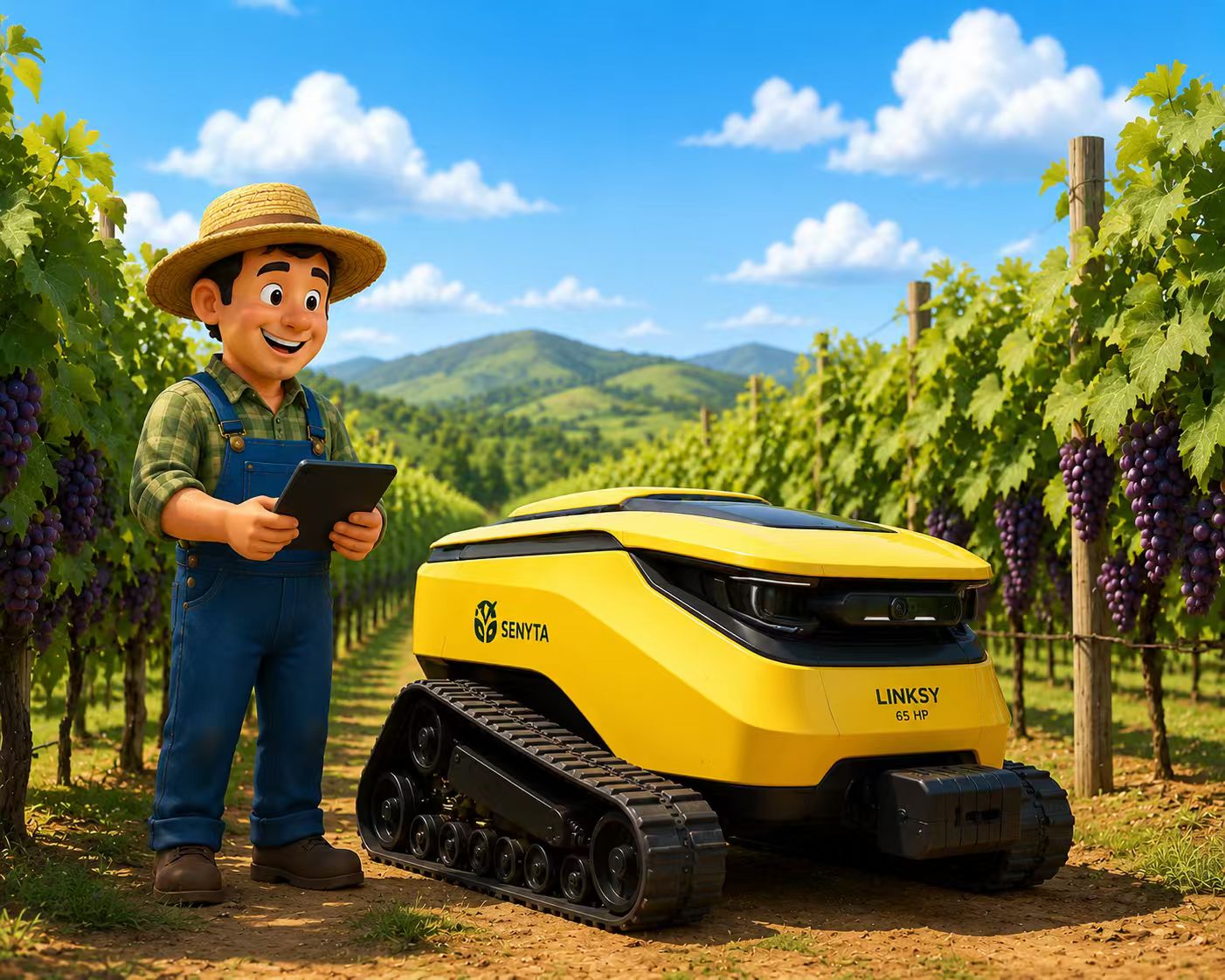
Senyta’s tracked agricultural platforms are designed to address these challenges. By using tracked mobility systems, these machines can achieve better ground contact and improved stability, allowing them to operate in complex terrain conditions.
For example, Senyta’s LINKSY Intelligent Agricultural Robot 65 HP is designed for modern agricultural applications that require high adaptability and autonomous operation. With a tracked chassis and intelligent control system, it can support various field operations in challenging environments, helping farmers reduce labor intensity and improve operational efficiency.
The goal is not to remove people from agriculture. The goal is to allow farmers to spend more time on higher-value activities such as crop planning, farm management, and decision-making.
Improving Efficiency Through Precision Agriculture
Modern agriculture is not only about doing more work — it is about doing the right work at the right time and in the right way.
Traditional agricultural operations often rely heavily on manual experience. For example, spraying operations can be affected by uneven coverage, excessive chemical usage, or inconsistent application.
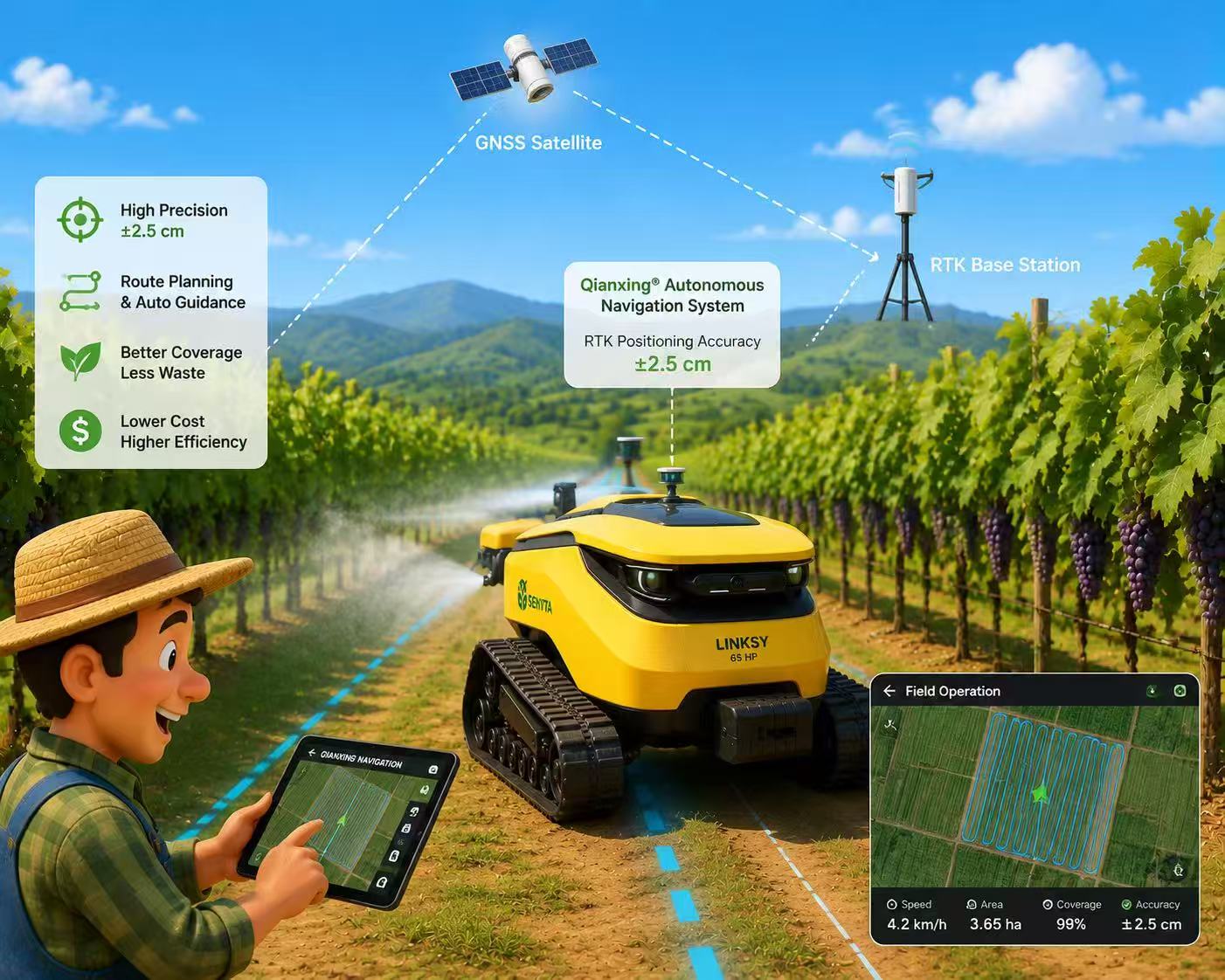
Agricultural robots combined with precision navigation technologies can make farming operations more accurate and efficient.
Senyta integrates intelligent navigation solutions into agricultural equipment through its Qianxing autonomous navigation system, which provides RTK positioning accuracy of approximately ±2.5 cm. With precise positioning and route planning, agricultural machines can follow planned paths more accurately, reducing repeated operations and improving resource utilization.
The company’s intelligent spraying equipment is designed to support modern agricultural applications, helping farmers improve spraying efficiency while reducing unnecessary consumption of water and agricultural inputs.
For farmers, precision technology means better control of production costs and improved long-term agricultural sustainability.
From Individual Machines to Smart Agricultural Solutions
Agricultural robots are not only about creating autonomous machines. The future of agriculture requires a complete ecosystem that combines equipment, navigation, data, and management systems.
A single machine can complete a task, but connected agricultural solutions can help farmers manage entire production processes more effectively.
Senyta is developing a range of smart agricultural solutions, including autonomous agricultural machinery, tracked operation platforms, intelligent spraying systems, inspection robots, and smart farm management platforms.
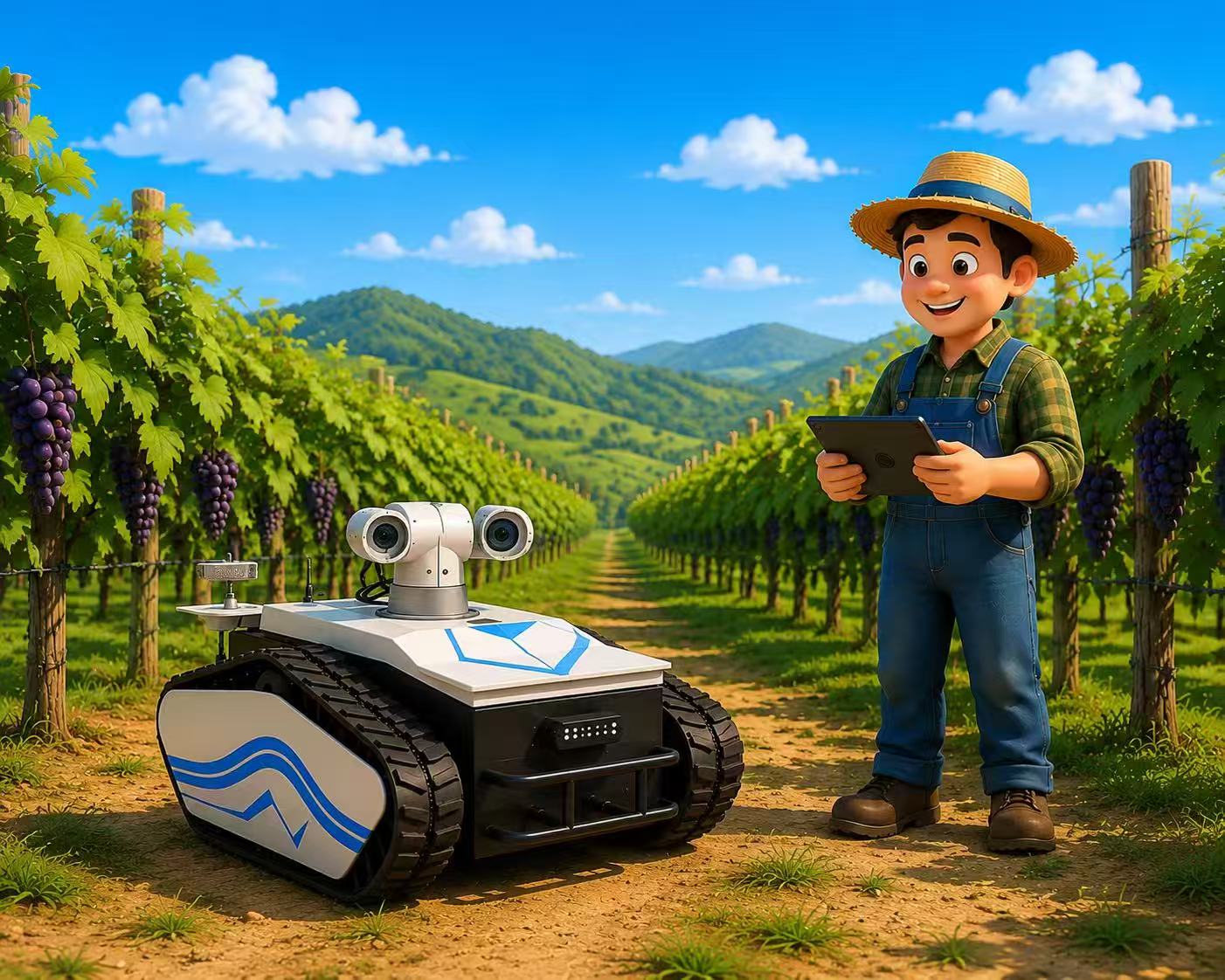
For example, intelligent inspection robots can support agricultural monitoring by collecting information through cameras and sensors, helping users better understand field conditions and make more informed decisions.
Through digital management systems, farmers can move from traditional experience-based farming toward data-driven agricultural management.
Farmers and Robots: A Partnership for the Future
The development of agricultural robots does not mean that farmers will disappear. Instead, it represents a new relationship between people and technology.
Farmers will continue to play the most important role in agriculture because farming requires knowledge, experience, and decision-making. Robots simply provide stronger tools to help farmers work more efficiently.
Machines can handle repetitive, physically demanding, and high-risk operations, while farmers can focus on improving production strategies and managing their businesses.
The future of agriculture is not about replacing humans with machines. It is about combining human expertise with intelligent technology.
As agricultural challenges continue to grow, agricultural robots will become valuable partners for farmers around the world, helping build a more efficient, sustainable, and intelligent farming future.
Senyta is committed to developing practical agricultural technologies that support farmers and provide reliable solutions for modern agriculture.
Media Contact
Company Name: Senyta Intelligent Equipment Co., Ltd
Email: Send Email
Country: China
Website: https://www.sydauto.com/


