Virse Connects Product Photo Variations, Clay Renders, and Seedance Video
Dover, Delaware – Nov. 21, 2026 – Virse has connected three commercial product staging workflows with multimodal video synthesis inside its node-based Creative Canvas. Designed for e-commerce brands, commercial studios, and industrial design teams, the workspace links still image variations, hand-held product compositing, 3D grey clay rendering, and 30-second audio-video generation around 40+ AI models so approved products move from early CAD geometry to launch media on one screen.
Product launches rarely stall because a team lacks ideas. They stall between handoffs. An industrial designer exports a grey clay pass from CAD software and waits overnight for a traditional shader queue just to compare four anodized finishes. Down the hall, a marketplace manager holds one white-background bottle shot that needs a real hand holding it for social ads, three seasonal tabletop backdrops, and a short motion clip for the storefront carousel. Splitting that work across isolated render engines, external retouchers, and standalone video apps breaks visual continuity. Packaging labels drift, and lighting shifts from shot to shot.
Virse keeps the approved product anchored on one workspace while specialists build adjacent nodes. Verified geometry and studio stills pass directly between stages, letting creative teams keep the full project brief in sight instead of rebuilding prompt context from zero. Nobody rebuilds the brief from scratch at each step.
Staging variations, lifestyle hands, and clay finishes on one canvas
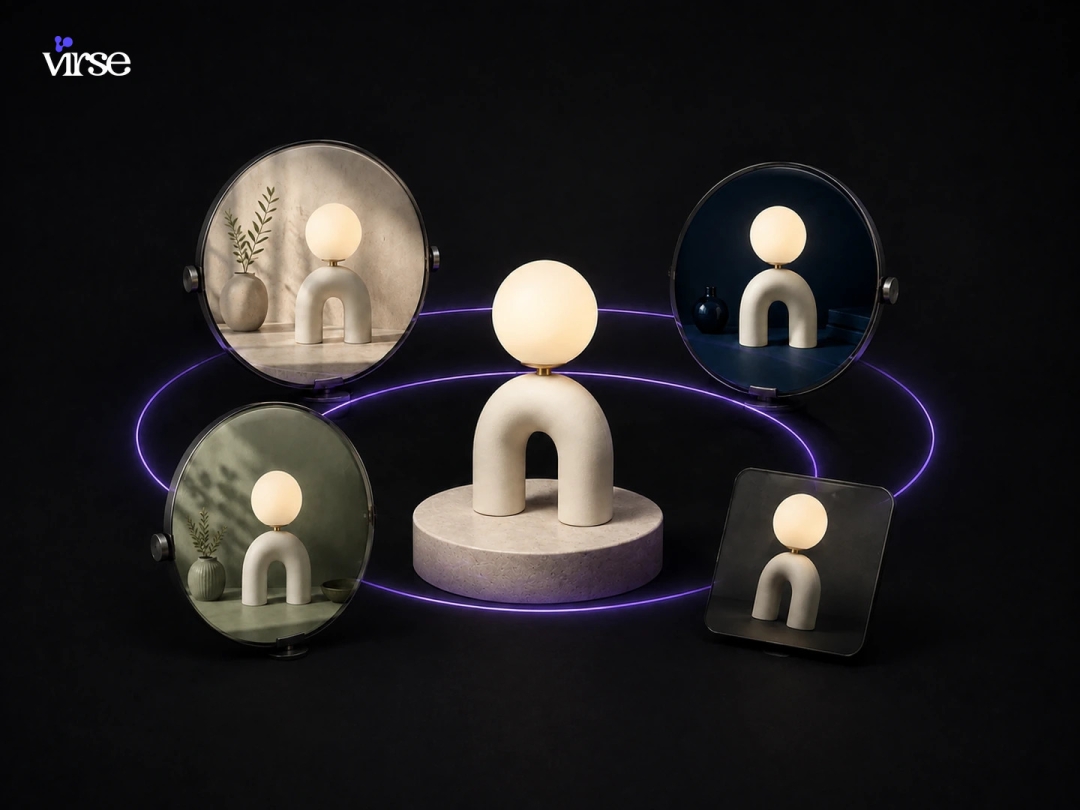
Catalog teams that already own a clean hero packshot or illustration often open the AI image variation generator first. After uploading one source image, a designer notes whether the backdrop, lighting mood, color palette, or camera angle should shift while the core object stays intact. Candidate frames land right next to the original photo on the canvas. Art directors approve clean scenes in seconds and delete drifted frames on sight. Because generative batches produce close visual relatives instead of pixel-identical CAD copies, retouchers still verify fine label typography and cap proportions before publishing product listings. That manual check takes minutes.
When a campaign needs human scale without booking a full studio crew, teams route the packshot into the model holding product compositor. Unlike text-only generators that invent synthetic faces, this tool requires two real uploaded photographs: a licensed model portrait and a clean product frame. A short pose note specifies one hand or two, held toward the camera or mid-use at chest height, so fingers wrap naturally around the item while label text stays sharp and studio shadows match across skin and packaging. Users remain responsible for holding proper commercial rights to any talent photograph they upload.
Hardware and housewares teams working earlier in product development start straight from CAD geometry inside the clay model render tool. Engineers upload an untextured grey 3D pass with clear form shadows and visible part breaks, such as distinct body, grip, and bezel seams. Plain-language finish notes like brushed aluminum or soft-touch polymer pair with a comma-separated list of colorways. Virse then outputs one, two, or four studio-lit shots locked to the exact same camera angle and lighting rig, making material differences plain to read side by side. The workflow runs strictly in one direction: grey 3D clay pass in, finished product shot out. It does not convert finished lifestyle photos back into clay models, nor does it render flat 2D pencil sketches.
“E-commerce and hardware teams lose entire days rebuilding the same product context every time a launch asset moves from a 3D review to a lifestyle ad or a short video clip,” said a spokesperson for Virse. “Placing subject-locked variations, two-photo hand compositing, clay rendering, and multimodal video on one canvas keeps the verified product at the center of every asset.”
Carrying approved stills into Seedance 2.5 video clips
Once still imagery passes creative review, paid subscribers route approved packshots, lifestyle hand shots, and colorway renders straight into Seedance 2.5 on the same workspace. Seedance 2.5 produces audio-video clips lasting up to 30 seconds in one generation. Vocals, music tracks, and ambient room sound render in sync with camera motion inside a single pass.
Directors steer each sequence using structured multimodal inputs and timeline cues instead of vague style adjectives. A single brief accepts up to 30 image references for products, props, talent, and interiors, paired with up to 10 video references for camera movement or pacing and up to 10 audio clips for rhythm and voice direction. Teams assign explicit roles to each asset, specify camera moves such as a slow dolly in or a low-angle orbit across timestamped beats, and extend finished clips across multiple rounds while holding characters and props steady.
Approved nodes stay grouped inside Virse Asset Folders alongside Virse Composer for localized edits and Aesthetic Memory for recurring brand standards. Still-image tools and 1K image models are open on Virse’s Free tier, where new accounts start with 200 complimentary compute credits and receive a 50-credit daily refill whenever balances dip below 200. Video models like Seedance 2.5 and higher-resolution image outputs run on Basic, Pro, Max, and Business plans, with Business tiers supporting up to 50 seats across Draft, Image, and Image plus video roles.
About Virse
Virse develops a node-based visual AI workspace created by machine learning researchers and industrial designers whose collective work has earned more than 100 international design awards. Based in Dover, Delaware, the platform combines 40+ AI image, video, and text models with Virse Composer and Aesthetic Memory on an infinite canvas. Commercial photo studios, hardware brands, and e-commerce teams rely on Virse to carry early prototypes through final storefront visuals inside one collaborative environment.
Media Contact
Company Name: Virse
Contact Person: Media Relations
Email: Send Email
Country: United States
Website: https://www.virse.ai/


