UCM Upholstery Cleaning Baltimore Shows What Technicians Check When an Older Sofa Has No Care Label
What Happens When the Cleaning Instructions Are Gone?
Furniture care labels typically contain a code indicating which cleaning agents are suitable for the upholstery. The common codes include W for water-based cleaners, S for solvent-based products, WS for either category, and X for vacuuming or gentle brushing only.
Yet a cleaning code cannot answer every question. The Joint Industry Fabric Standards and Guidelines acknowledge that these codes are useful but provide insufficient information for every upholstery cleaning decision.
The issue becomes more complicated with older sofas. The upholstery may have been repaired, individual cushions replaced, or the entire piece recovered years after its original purchase. Even a surviving label may refer to a fabric that is no longer on the furniture.
During its years of upholstery cleaning in Baltimore, UCM has encountered furniture with faded or missing manufacturer tags. Its technicians have found replacement cushions that closely matched the original upholstery in color but reacted unexpectedly during fabric testing.
A visual match, in other words, provides little assurance about cleaning compatibility.
What Technicians Check on an Unlabeled Sofa
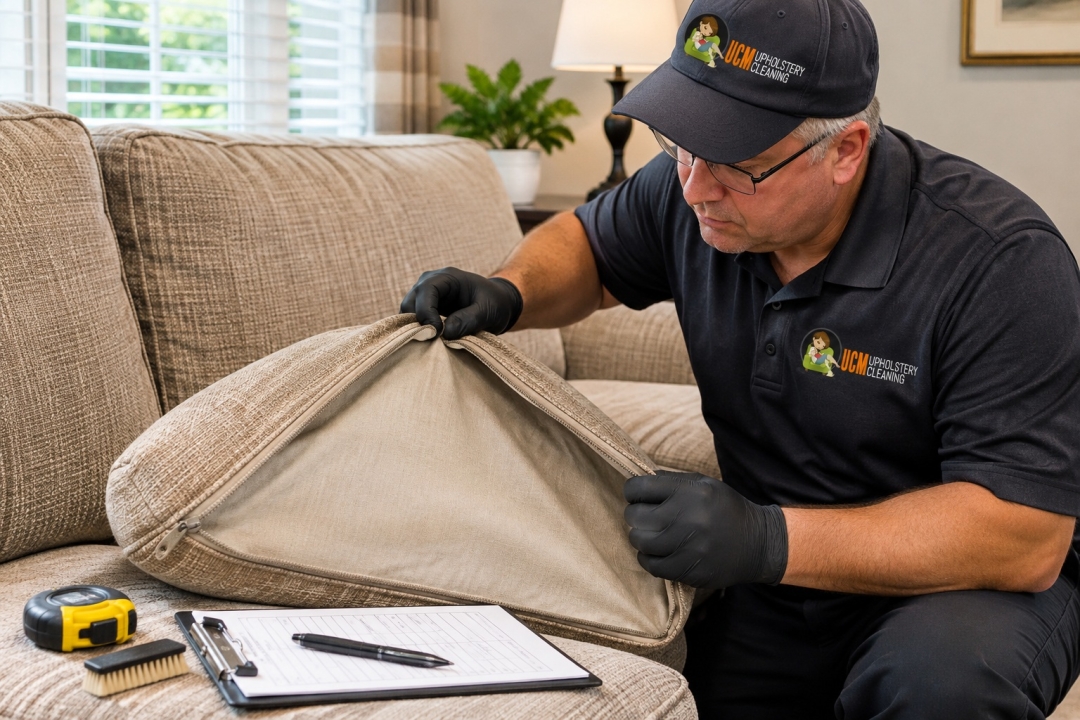
According to UCM Upholstery Cleaning Baltimore, an upholstery cleaning appointment starts with an inspection. The technician examines the fabric and its condition to determine which cleaning approach may be appropriate.
For an older sofa with no readable care instructions, several details deserve attention:
-
Fabric identification. The technician examines the weave, surface texture, and other material characteristics. If the manufacturer or fabric information can be identified, those records may provide useful cleaning instructions.
-
Signs of fabric deterioration. Worn armrests, weakened stitching, loose piping, and thinning upholstery can limit the amount of agitation or moisture the furniture can tolerate.
-
Previous cleaning attempts. Water rings, stiff patches, or residue from household products can indicate earlier treatment. These areas warrant closer inspection.
-
Color stability. A carefully selected test in a concealed area can indicate potential dye transfer, discoloration, or changes in appearance. Results should be evaluated after the test area dries.
-
Cushion construction. The technician considers the backing, padding, and other components that could be affected by moisture during cleaning.
A successful test in one concealed area does not guarantee the same result across the entire sofa. Age, wear, previous repairs, and fabric construction must be considered together.
Why Two Matching Cushions Required Separate Tests
Peter M., a Baltimore resident, contacted UCM Upholstery Cleaning Baltimore to arrange cleaning for an older sectional sofa. The manufacturer’s care label had faded, and Peter could no longer read the cleaning instructions. He mentioned that one seat cushion had been replaced several years earlier, although its color and texture appeared nearly identical to the original upholstery.
During the inspection, the UCM’s technician examined the replacement cushion separately. A test in a concealed area showed that the newer fabric reacted to moisture in a way the original upholstery did not. Although the cushions looked nearly identical, applying the same cleaning procedure to both could have produced uneven results.
The technician took these findings into account when selecting the cleaning approach for each section of the sofa.
Peter’s case illustrates why the appearance of older furniture cannot be the only factor in choosing a cleaning method. Even matching cushions can contain materials with distinct cleaning requirements, particularly if the furniture has undergone repairs or partial reupholstering.
What Homeowners Should Know About Older Sofas
For Baltimore residents who own inherited furniture, secondhand sofas, or seating that has been reupholstered, a missing care tag is worth mentioning when arranging professional cleaning.
Owners can search beneath seat cushions, along the underside of the frame, and inside cushion seams for surviving manufacturer information. Original purchase records or details about previous upholstery work may provide further clues.
It is equally useful to disclose any household cleaning products previously applied to the sofa. Old treatments can affect how the fabric responds to subsequent cleaning.
The absence of a care label does not automatically rule out professional cleaning. It does, however, call for a closer assessment of the material, its current condition, and the risks associated with the proposed method.
A Closer Look Can Prevent an Expensive Mistake
Older upholstery presents questions that a manufacturer tag, even an intact one, cannot always resolve. A sofa may have sturdy cushions but weakened stitching. Its original fabric may remain in good condition, yet a replacement seat could require another cleaning approach.
Homeowners considering professional cleaning for older furniture should be prepared to discuss its history and any previous treatments. Those details, combined with a careful examination, can establish more realistic expectations for the cleaning process.
About UCM Upholstery Cleaning Baltimore
UCM Upholstery Cleaning Baltimore has provided professional upholstery cleaning services, including stain treatment, pet odor removal, and fabric protection, to residential and commercial customers in Baltimore, Maryland, since 2005. Its technicians assess fabric type, condition, and color stability to select suitable cleaning methods, including steam extraction and low-moisture cleaning. UCM serves Baltimore and surrounding communities, including Canton, Federal Hill, Fells Point, Hampden, Roland Park, Dundalk Cityside, and Towson.
Media Contact
Company Name: UCM Upholstery Cleaning
Contact Person: Daniel Dougherty
Email: Send Email
Phone: 443-842-6344
City: Baltimore
State: MD
Country: United States
Website: https://www.upholsterycleaningbaltimore.com/


