How AI Is Transforming Warehouse Automation and Robotics Operations
Chengdu, Sichuan, China – October 24, 2026
Warehouse automation and robotics? It’s not just some futuristic idea anymore—it’s becoming part of everyday warehouse operations. You’ve got autonomous mobile robots hauling totes between the aisles, and vision systems checking labels and package dimensions. Robotic arms can handle repetitive picks, sure, but they still have trouble with clear packaging, beat-up cartons, and weirdly shaped products. And honestly? It’s these little details that really matter out on real warehouse floors.So, the International Federation of Robotics says there were 541,302 industrial robots installed around the world in 2023 — and the total number in operation? That’s now over 4.28 million. It’s a figure that covers all sorts of industries, sure, but it still says a lot about how mature Robotic Systems are getting. Meanwhile, the MHI 2024 Annual Industry Report put AI high on the list of things shaping supply chains. In fact, 55% of the people they surveyed expect it to have a big impact within just two years. DHL’s Logistics Trend Radar also calls out AI, robotics, and autonomous operations as big logistics trends. And honestly? Reports like this can help back investment decisions—but they won’t guarantee quick returns.So, how does AI actually make Warehouse Automation And Robotics better? Well, it kind of ties together a bunch of things—order forecasts, inventory data, robot routes, and even the choices people make. A warehouse management system can guess what demand will look like, hand out picking tasks, and reroute robots if an aisle gets too busy. And computer vision? It can catch missing labels before stuff ships out. Predictive maintenance can also notice weird motor vibrations—before a conveyor goes down.Look, this tech is powerful – no doubt about it. But it’s not perfect. If your data is bad, you’ll still get bad decisions. And sure, a robot can zip around quickly, but without careful workflow design, it might just make congestion worse. To adopt it successfully, you need measurable pilots, trained operators, safety reviews, and performance targets everyone can see. Amazon, DHL, Ocado? They all show different ways to do it, but that doesn’t mean their playbook will work for you. Every warehouse really needs its own evidence. Often, the best move is to start small: one process, one site, and honest results.
 Understanding AI’s Role in Warehouse Automation and Robotics
AI is becoming the decision layer behind Warehouse Automation And Robotics.Robotics And Automation Technology can now connect cameras, sensors, inventory data, and mobile machines.
It helps systems recognize a damaged carton, predict replenishment needs, and adjust routes when an aisle becomes crowded. The International Federation of Robotics reported 541,302 industrial robots were installed worldwide in 2023. This figure shows expanding automation, but industrial robots are only one part of warehouse intelligence.
In a working warehouse, AI may detect a misplaced tote beside a packing station. A vision system flags it, while software updates the task queue and sends a robot toward the correct location.
Predictive models can also identify battery decline before a machine stops during a night shift. The MHI 2024 Annual Industry Report found that many supply chain professionals expect artificial intelligence and robotics adoption to accelerate within the next five years. Adoption is not automatic, though. Poor inventory records can teach an algorithm the wrong lesson. That happens.
Reliable deployment requires clean data, measurable safety controls, and human review. Supervisors should test recommendations against real picking times, exception rates, and near-miss reports. Digital twins can simulate congestion before a new workflow reaches the floor.
Yet simulations may miss loose shrink wrap, tired workers, or sudden order spikes. Experience still matters. AI should support judgment, not quietly replace it.
Warehouses also need clear access controls and audit trails when automated decisions affect staffing, inventory, or customer delivery promises.
Assessing Warehouse Needs and Selecting Suitable AI Technologies
Warehouse automation should begin with observation, not a technology catalogue. Walk through receiving, storage, picking, packing, and dispatch during a busy shift. Record travel distances, queue times, lifting frequency, damaged goods, and manual errors. A simple floor map can reveal that one narrow aisle causes more delays than expected. Start with evidence.Interview operators as well as supervisors. They know where scanners fail, cartons jam, and safety risks appear. Review order patterns, product sizes, seasonal peaks, and available network data. A warehouse with stable item locations may suit robotic picking support. Another with irregular products may need computer vision and decision software instead. Robotics And Automation must fit the workflow, not replace judgment blindly.Select technologies against measurable needs. Define targets for accuracy, throughput, recovery time, training effort, and worker safety. Test one controlled process before changing the entire site. For example, a pilot can track whether an AI vision system identifies mixed cartons under uneven lighting. Keep human approval for unusual items and system exceptions. Data quality is often weaker than planned. That is an uncomfortable finding, but it matters. Review privacy, cybersecurity, maintenance access, and legal requirements before deployment. A cheaper system may create hidden costs through integration delays or frequent manual corrections. Ask vendors for performance evidence from similar operating conditions, not polished demonstrations. Then document every assumption, including the ones that may prove wrong.
How to Use AI for Warehouse Automation And Robotics? – Assessing Warehouse Needs and Selecting Suitable AI Technologies
| Warehouse Area | Typical Operational Challenge | Key Data Required | Suitable AI Technology | Recommended Automation Type | Current-State Indicator | Potential Improvement Range | Implementation Complexity | Priority |
|---|---|---|---|---|---|---|---|---|
| Receiving and Dock Scheduling | Uneven arrival patterns, dock congestion, manual appointment changes, and long truck waiting times. | Arrival timestamps, appointment records, unloading duration, dock availability, supplier lead times, and shipment volume. | Demand forecasting, time-series prediction, constraint-based scheduling, and anomaly detection. | AI-assisted dock scheduling with automated appointment recommendations. | Dock utilization below 60% during some periods and above 90% during peak periods. | 10–25% reduction in average truck waiting time; 5–15% improvement in dock utilization balance. | Medium | High |
| Put-Away and Slotting | Excessive travel distance, poor product placement, frequent replenishment, and inconsistent storage decisions. | SKU dimensions, weight, velocity, order frequency, location history, replenishment records, and travel distance. | Clustering, optimization algorithms, demand classification, and reinforcement learning. | AI-generated slotting recommendations supported by warehouse management rules. | High-velocity items are not consistently stored near appropriate picking or dispatch zones. | 10–30% reduction in picker travel distance; 5–20% improvement in storage density. | Medium | High |
| Inventory Accuracy | Stock discrepancies caused by manual counting, misplaced items, delayed updates, and unidentified damage. | Cycle-count results, scanner events, stock adjustments, location changes, item images, and inventory movement history. | Anomaly detection, computer vision, probabilistic reconciliation, and predictive analytics. | AI-supported cycle counting using mobile devices, fixed cameras, or autonomous scanning systems. | Inventory accuracy commonly ranges from 95% to 99% depending on process discipline and product complexity. | 1–3 percentage-point improvement in inventory accuracy; 20–50% reduction in manual counting effort. | Medium | High |
| Order Picking | Long walking distances, variable order profiles, picking errors, and labor constraints during demand peaks. | Order lines, SKU velocity, picker paths, task duration, error records, congestion data, and workstation capacity. | Dynamic task allocation, route optimization, demand forecasting, and computer vision verification. | Pick-path optimization, goods-to-person systems, autonomous mobile robots, or robotic picking assistance. | Picking often represents more than half of direct warehouse labor in manual operations. | 15–40% reduction in travel time; 10–30% increase in lines picked per labor hour; 20–60% reduction in picking errors. | High | High |
| Robotic Item Handling | Irregular packaging, mixed-SKU totes, reflective surfaces, fragile products, and uncertain grasping conditions. | Item dimensions, package material, weight, orientation, grasp history, image data, and failure records. | Computer vision, object detection, pose estimation, machine learning, and robotic motion planning. | Robotic picking or depalletizing for standardized, high-volume, and visually distinguishable items. | Automation suitability is higher when packaging and item presentation are consistent. | 20–50% reduction in repetitive manual handling for suitable product groups; lower gains for highly variable items. | High | Medium |
| Packing and Carton Selection | Excess packaging material, inconsistent carton choice, manual quality checks, and avoidable shipping costs. | Item dimensions, order composition, carton sizes, void-fill usage, packing time, damage claims, and shipping weight. | Dimensional optimization, image-based quality inspection, predictive modeling, and combinatorial optimization. | AI-assisted cartonization, automated packing cells, and vision-based seal verification. | Carton selection is often rule-based and may not reflect actual item combinations or packaging constraints. | 5–15% reduction in packaging material; 5–20% reduction in packing time; fewer damage-related exceptions. | Medium | Medium |
| Internal Transportation | Manual replenishment requests, vehicle congestion, empty travel, and inefficient movement between storage and work areas. | Task queues, vehicle locations, battery status, aisle occupancy, travel times, priority rules, and replenishment demand. | Fleet orchestration, predictive task assignment, route optimization, and reinforcement learning. | Autonomous mobile robots, Automated Guided Vehicles, or hybrid human-robot transport. | Transport efficiency is reduced when tasks are assigned in batches instead of according to real-time demand. | 10–25% reduction in empty travel; 15–35% faster replenishment response; improved equipment utilization. | High | High |
| Packing and Dispatch Verification | Incorrect orders, missing items, wrong labels, and shipment delays caused by manual final checks. | Order contents, barcode scans, package images, label data, carrier cut-off times, and exception records. | Computer vision, optical character recognition, anomaly detection, and rules-based validation. | Automated scan-and-verify stations with AI-assisted exception handling. | Manual verification quality varies by workload, lighting, training, and product presentation. | 30–70% reduction in verification time; 20–50% reduction in shipment-related errors. | Low to Medium | High |
| Equipment Maintenance | Unexpected downtime, reactive maintenance, parts shortages, and limited visibility into equipment condition. | Motor current, vibration, temperature, fault codes, operating hours, maintenance history, and downtime events. | Predictive maintenance, anomaly detection, remaining-useful-life estimation, and sensor analytics. | Condition monitoring for conveyors, sorters, lifts, robots, and charging equipment. | Maintenance is often triggered by calendar intervals or equipment failure rather than measured condition. | 10–30% reduction in unplanned downtime; 5–15% reduction in maintenance cost when data quality is sufficient. | Medium | Medium |
| Workforce and Shift Planning | Demand volatility, overtime, uneven labor allocation, skill gaps, and insufficient coverage at critical workstations. | Forecasted workload, productivity rates, attendance, skills, shift availability, overtime, and task completion data. | Demand forecasting, workforce optimization, simulation, and prescriptive analytics. | AI-assisted labor planning with human approval and fairness constraints. | Labor requirements can vary significantly by day, season, promotion, and order cut-off time. | 5–15% reduction in overtime; 5–20% improvement in labor utilization; better peak-period coverage. | Medium | High |
| Safety and Traffic Monitoring | Pedestrian-vehicle interaction risks, blocked emergency routes, unsafe behavior, and limited incident visibility. | Camera feeds, proximity events, traffic patterns, near-miss reports, incident records, and zone restrictions. | Computer vision, object tracking, geofencing, and real-time anomaly detection. | AI-enabled safety monitoring with alerts and automated traffic-rule enforcement support. | Safety monitoring is frequently dependent on manual observation and incident reporting. | Faster detection of blocked zones and near misses; measurable improvement depends on site procedures and response time. | Medium | Medium |
| Returns Processing | Unpredictable workload, slow inspection, inconsistent grading, and delayed inventory disposition. | Return reason, product images, order history, condition grade, resale value, inspection time, and disposition outcome. | Image classification, natural language processing, anomaly detection, and decision-support models. | AI-assisted inspection, return classification, and automated disposition recommendations. | Returns are often processed through manual inspection and individual judgment. | 15–35% reduction in inspection time; faster routing to restock, repair, recycling, or liquidation workflows. | Medium | Medium |
| AI Readiness and Integration | Fragmented data, inconsistent item identifiers, limited historical records, weak system integration, and unclear ownership. | Data completeness, timestamp quality, system interfaces, master-data accuracy, cybersecurity controls, and governance rules. | Data-quality monitoring, API integration, process mining, digital twins, and model governance. | Phased deployment beginning with decision support before full physical automation. | AI projects perform best when operational data is timely, standardized, traceable, and accessible. | Shorter deployment cycles, fewer model exceptions, and improved return on automation investment. | High | High |
Warehouse automation starts with a clear map, not a robot purchase. Record every movement from receiving to dispatch. Capture item dimensions, order frequency, travel distance, pick errors, and waiting time. A simple warehouse map can reveal repeated walking near packing stations. It can also expose poor slotting decisions.AI can compare these patterns with labor schedules and order histories. It may suggest dynamic slotting, guided picking, or automated transport. MHI’s 2024 Annual Industry Report found that 55% of supply chain leaders planned to increase investment in innovation. The International Federation of Robotics reported 541,302 industrial robots installed worldwide in 2023. These figures show strong automation momentum, but warehouse needs remain highly specific. A robot may reduce travel while creating congestion at a narrow aisle. Our first process map may be wrong. That is useful.Tips: Start with one measurable problem. Map ten typical orders by hand. Mark idle time beside each workstation. Test AI recommendations against real shift data. Keep human approval for unusual orders and safety decisions. Review the results after two weeks, not two hours. Small pilots often expose missing data, inconsistent labels, and unrealistic assumptions. Use those failures to improve the map before expanding automation.
How to Use AI for Warehouse Automation and Robotics?
Mapping warehouse data, processes, and automation opportunities
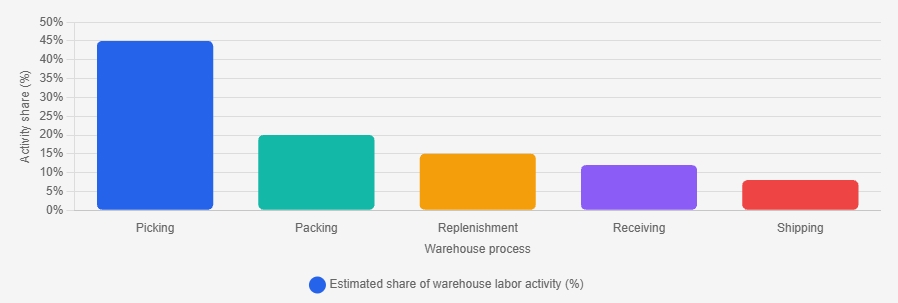
The benchmark illustrates how warehouse labor activity is commonly distributed across major processes. Picking and packing usually represent the largest automation opportunities because they are repetitive, data-rich, and measurable through order, travel-time, and error-rate data. AI can prioritize robotics investments by comparing labor intensity, process variability, safety exposure, and expected productivity gains.
Integrating AI with Robots, Sensors, and Warehouse Management Systems
Warehouse automation works best when AI connects robots, sensors, and the warehouse management system (WMS).
The robot should not operate as an isolated machine. It needs live task data, inventory locations, traffic rules, and human instructions from the WMS.
The numbers support this shift. The International Federation of Robotics reported 541,302 industrial robots were installed worldwide in 2023.
The MHI 2024 Annual Industry Report found that artificial intelligence adoption could rise from 14% to 73% within five years.
These figures show strong momentum, but deployment still requires careful engineering.
A practical system combines cameras, weight sensors, barcode scanners, and location signals. AI can detect a damaged carton or predict congestion near a picking aisle.
The WMS then adjusts priorities, while mobile robots receive safer routes. Small delays matter. A two-second scanning error can multiply across thousands of orders.
Data quality remains the difficult part. Old inventory records can mislead intelligent systems. Poor sensor calibration creates false alerts. The first deployment rarely behaves perfectly.
Operators should review exceptions daily and test emergency stops regularly. Clear APIs help connect equipment without creating fragile workarounds. Managers should also measure picking accuracy, travel time, energy use, and near-miss events.
This transition will reshape Robotics And Automation Jobs.
Workers may supervise fleets, validate AI decisions, and maintain sensor networks. Training is essential, although many programs underestimate the time required.
A warehouse can be technically advanced and still feel confusing on the floor.
Training, Testing, and Deploying AI-Driven Warehouse Operations
AI-driven warehouse operations begin with disciplined training, not a rushed robot purchase. Teams should train models on real order histories, aisle maps, item dimensions, and seasonal exceptions. A clean dataset matters. Missing scans can teach an AI system the wrong picking route.The International Federation of Robotics reported 553,052 industrial robots installed worldwide in 2022. Warehouse teams therefore need practical skills in sensor calibration, simulation, safety checks, and human-machine coordination. Training should include unusual events, such as blocked aisles, damaged cartons, and sudden demand spikes. The World Economic Forum’s Future of Jobs Report 2023 found that 44% of workers’ skills may be disrupted by 2027. Short, repeated lessons can reduce that gap. Still, classroom training alone is insufficient.Test carefully. Use digital simulations before live deployment, then run limited trials beside experienced workers. Measure pick accuracy, travel distance, downtime, near misses, and recovery time. A system that moves quickly but mislabels inventory is not intelligent enough. Small failures reveal important weaknesses.Deployment should be gradual. Keep manual overrides available, record every model decision, and review performance weekly. Operators must know when to stop automation. This is often ignored. A warehouse can become less resilient when staff trust predictions without questioning them. AI should support judgment, not replace responsibility. Mistakes will happen, and some pilots should be stopped early. That is useful evidence, not wasted effort.
Monitoring Performance, Safety, and Continuous System Improvement
Warehouse automation should be measured beyond throughput.According to the International Federation of Robotics’ World Robotics 2024 report, 541,302 industrial robots were installed globally in 2023. Their operational stock reached 4.28 million units. This scale makes continuous monitoring essential. AI can compare cycle time, battery use, route deviations, and repeated stoppages in near real time. A dashboard might flag a robot slowing near aisle 12 before orders begin to pile up.
Safety requires more than emergency buttons.Computer vision can identify blocked walkways, unusual human-machine proximity, or pallets leaning outside safe limits. However, false alerts remain a practical weakness. Too many warnings may train workers to ignore the system. Supervisors should review alert precision weekly, test sensor coverage, and record every intervention. ISO 3691-4 guidance for driverless industrial trucks also supports risk-based validation, not blind reliance on software.
The improvement loop needs people.The World Economic Forum’s Future of Jobs Report 2023 estimates that 44% of workers’ core skills may change by 2027. Warehouse teams therefore need short, task-specific training after each system update. Robotics And Autonomous Systems perform better when operators explain exceptions, not merely follow instructions. AI may recommend a faster route, yet a worker may notice seasonal congestion that the data misses. That gap deserves investigation. Mistakes should be logged openly. Guesswork should not.
High-Performance Mobile Robot Chassis AMB-CSW10-BH: Features, Applications, and Buying Guide
High-Performance Mobile Robot Chassis AMB-CSW10-BH – 1T Load Capacity from China Suppliers and Factory
The AMB-CSW10-BH high-performance mobile robot chassis is designed for reliable and efficient material handling in industrial environments. With a rated load capacity of up to 1,000 kg, it can support demanding logistics tasks such as warehouse transport, production-line delivery, and automated equipment movement. Its compact minimum turning radius of 1,220 mm allows smooth navigation through narrow aisles and busy workspaces.Built for continuous operation, the chassis offers up to eight hours of battery life and a maximum driving speed of 1.5 m/s. Its positioning performance, with accuracy of approximately ±5 mm and angular accuracy of ±0.5°, helps improve route consistency and handling precision. A lidar detection range of up to 3,000 mm supports obstacle awareness and safer autonomous movement.For buyers, this universal chassis provides a practical balance of load capacity, operating endurance, navigation performance, and cost efficiency. It can be integrated into customized mobile robot solutions for factories, warehouses, and other material-handling applications. Sourced directly from a professional Chinese manufacturer and supplier, it is a dependable choice for businesses seeking scalable automation equipment and improved logistics productivity.
Conclusion
AI is transforming Warehouse Automation And Robotics by helping organizations analyze operations, identify inefficiencies, and make faster, more accurate decisions. How Does Ai Improve Warehouse Automation And Robotics is answered through intelligent task planning, demand forecasting, inventory visibility, route optimization, and real-time coordination between people, machines, and software. The process begins by assessing warehouse goals, constraints, workflows, and safety requirements before selecting suitable AI technologies such as computer vision, predictive analytics, machine learning, and intelligent control systems.Successful implementation requires mapping data, processes, equipment, and automation opportunities, then integrating AI with robots, sensors, and warehouse management systems through reliable data connections. Organizations should train models with representative information, test performance in controlled conditions, and deploy solutions gradually to reduce operational risk. Continuous monitoring of productivity, accuracy, equipment behavior, and workplace safety helps identify problems early. By reviewing results and refining algorithms, warehouses can improve efficiency, flexibility, reliability, and employee support over time while maintaining responsible and compliant operations.
About Us
Taking the actual business needs as the cornerstone, SCP is committed to comprehensively innovating and enhancing the overall supply chain planning of enterprises. We provide enterprises with comprehensive end-to-end supply chain solutions, build a multi-role and multi-dimensional intelligent supply chain collaboration system, and achieve all-round efficient collaboration and process optimization.
Media Contact
Company Name: Sichuan Supply Chain Power Chain Technology Co., Ltd.
Contact Person: Media Relations
Email: Send Email
Country: China
Website: https://www.pallixbot.com/


