Key Factors Guide the Selection of a Pressure Gauge Manufacturer in China
Zhuhai, Guangdong, China – September 23, 2026
When you’re trying to pick the best Pressure Gauge manufacturer in China, it’s about more than just comparing prices. The right supplier should really understand pressure measurement, industrial safety, and how their equipment performs over the long haul. It’s important for buyers to look into their product range, how much experience they have in manufacturing, their calibration processes, and quality control records. A trustworthy manufacturer will be upfront and clearly explain these details—vague promises just don’t cut it.
Start with what you actually need. Different applications—like chemical plants, water systems, labs, or hydraulic setups—call for different types of gauges. Think about pressure range, accuracy, connection sizes, case materials, temperature resistance, and whether the gauge is compatible with your media. If you search online using terms like “Absolute Pressure Atmospheric Pressure Gauge,” you might find products that seem like a match. But don’t just rely on these keywords—make sure to get technical details checked out. A good supplier should review your drawings, understand your operating conditions, and consider your installation environment before recommending a specific model.
It’s also smart to ask for proof. Do they provide calibration certificates, inspection reports, material info, and traceability records? If you’re buying internationally, certifications like ISO 9001 and compliance documents are helpful too. But keep in mind—certifications alone aren’t everything. You should also look into factory audits, sample testing, and how well they communicate. A company like Ningbo Precision Instruments Co., Ltd., for example, should be judged based on real, verifiable records—not just a fancy website.
Experience really counts here.
A solid partner will be able to support you with private labeling, custom dials, small trial orders, and spare parts. Quick replies are nice, but what’s more important is how accurate and reliable their engineering support is. Some buyers get caught up only in unit costs and overlook critical factors like leaks, vibrations, or calibration drift—big mistakes that can end up costing a lot later on. Even if you’ve been in the game for a while, it’s a good idea to question your assumptions and test samples under real working conditions.
Ultimately, the best choice balances solid technical expertise, transparent and friendly service, stable production, and trustworthy after-sales support. It’s all about finding that sweet spot where quality and reliability meet your needs.

What Is a Pressure Gauge and Why Does the Manufacturer Matter?
A pressure gauge measures the force exerted by a gas or liquid inside a system. It may show gauge pressure, which compares system pressure with surrounding air. Absolute pressure includes atmospheric pressure as a reference. The phrase Absolute Pressure Gauge Pressure Atmospheric Pressure helps explain these different readings. Choosing the correct type prevents false measurements, damaged equipment, and unsafe operating decisions.
The manufacturer matters because accuracy begins before the gauge reaches your facility. A dependable Chinese manufacturer should explain its calibration process, pressure range, materials, connection size, and temperature limits. Ask for test records and product samples. In practical use, a gauge exposed to vibration may need a stronger case or liquid-filled design. A supplier that understands this detail offers more than a low price. It offers useful engineering judgment. Still, no checklist is perfect. Specifications can look impressive on paper and perform poorly in the field.
Tips: Request a clear datasheet and calibration certificate. Confirm whether readings are gauge or absolute pressure. Check seals and wetted materials for chemical compatibility. Discuss delivery inspections and replacement parts before ordering. Visit the factory virtually or in person when possible. Observe how workers test dials, connections, and pressure resistance. Small questions often reveal the manufacturer’s real experience.
Which Pressure Gauge Specifications Should You Define First?
Before comparing a pressure gauge manufacturer in China, define the measurement task clearly. Identify the medium, pressure range, accuracy, and operating temperature. These details prevent attractive but unsuitable quotations.Decide whether you need Atmospheric Pressure Gauge Pressure And Absolute Pressure measurement. Gauge pressure compares with local atmospheric conditions. Absolute pressure references a vacuum, while atmospheric pressure gauges measure surrounding air pressure. The difference matters in pumps, tanks, laboratories, and process equipment. A wrong reference can produce misleading readings.Specify the connection size, thread standard, dial diameter, case material, and wetted parts. Stainless steel may suit corrosive environments, but it is not automatically the best choice. Consider vibration, humidity, pulsation, and installation direction. A glycerin-filled case can steady the pointer near a vibrating compressor.Accuracy class should match the application, not merely the sales sheet. A tighter tolerance often increases cost without improving the process. I once selected an overly precise gauge for a rough utility line; the extra precision added little value. That choice needed more reflection.Ask manufacturers for calibration records, material details, dimensional drawings, and sample inspection procedures. Confirm how they test leakage, overload resistance, and pointer stability. Request evidence from comparable applications, while checking whether the documents are current. Reliable suppliers should answer technical questions consistently, not only provide a low price. Small details matter.
How to Choose the Best Pressure Gauge Manufacturer in China? – Which Pressure Gauge Specifications Should You Define First?
| No. | Specification to Define | Common and Valid Options | Practical Selection Guidance | Typical Verification Method | Relevant Reference |
|---|---|---|---|---|---|
| 1 | Measured Pressure Type | Gauge pressure, absolute pressure, vacuum pressure, compound pressure, or differential pressure | Define the reference pressure first. Gauge pressure is referenced to atmospheric pressure, while absolute pressure is referenced to a vacuum. | Compare the process measurement point with the required reference point and control philosophy. | Process design specification |
| 2 | Pressure Range | Examples: 0–1 bar, 0–10 bar, 0–16 bar, 0–25 bar, 0–40 bar, 0–100 bar, or equivalent psi ranges | Select a full-scale range that safely exceeds the normal operating pressure. The operating point is commonly kept near the middle of the scale for better readability and measurement life. | Check normal, maximum, pulsating, and accidental overpressure conditions. | EN 837-1; ASME B40.100 |
| 3 | Units and Scale | bar, kPa, MPa, psi, inHg, kgf/cm², or dual-scale combinations | Use the unit required by the operating team and local regulations. Avoid crowded scales that reduce reading clarity. | Verify unit symbols, graduations, zero position, and scale direction on the approved drawing. | ISO 80000-1; project documentation |
| 4 | Accuracy Class | Typical analog classes include 0.5, 1.0, 1.6, and 2.5% of span | A lower percentage indicates a tighter accuracy limit. Specify the required accuracy based on process control, safety, and calibration requirements rather than choosing the lowest value automatically. | Request calibration results at multiple increasing and decreasing pressure points. | EN 837-1; ASME B40.100 |
| 5 | Process Connection | Threaded connections such as G 1/4, G 1/2, 1/4 NPT, and 1/2 NPT; other hygienic or flanged connections may also be required | Define thread standard, nominal size, connection location, and sealing method. NPT and BSP/G threads are not interchangeable. | Check the mating connection drawing, thread gauge, and leak-test record. | ISO 7-1; ASME B1.20.1 |
| 6 | Wetted-Part Material | Copper alloy, 304 stainless steel, 316 stainless steel, or special alloys for corrosive media | Select materials according to chemical compatibility, temperature, cleanliness, and corrosion resistance. 316 stainless steel is frequently specified for more demanding corrosive or hygienic services. | Review the media compatibility chart and material certificates where required. | EN 837-1; ASTM material specifications |
| 7 | Case and Window Material | Painted steel, stainless steel, engineering polymer, glass, safety glass, or polycarbonate window | Choose based on corrosion exposure, impact risk, visibility, hygiene requirements, and installation environment. | Inspect material, finish, window retention, and impact-protection requirements. | EN 837-1; IEC 60529 where applicable |
| 8 | Dial Size and Mounting | Common nominal dial sizes include 40, 50, 63, 80, 100, 115, and 160 mm | Larger dials improve readability from a distance. Specify bottom, back, or center-back connection and direct, panel, or surface mounting. | Confirm panel cutout, mounting clearance, connection orientation, and viewing distance. | Manufacturer drawing; EN 837-1 |
| 9 | Operating Temperature | Ambient and process-temperature limits stated separately; common ambient ranges are approximately −20 to +60 °C or wider depending on construction | Consider ambient temperature, process temperature, thermal expansion, and whether a diaphragm seal, cooling element, or capillary is needed. | Compare actual site temperatures with the gauge data sheet and perform temperature-effect evaluation when necessary. | EN 837-1; project environmental specification |
| 10 | Overpressure and Pressure Pulsation | Standard gauge, overpressure-resistant design, pulsation-resistant movement, liquid-filled case, or snubber installation | Use protective measures for pump discharge, compressor service, water hammer, rapid cycling, or pressure spikes. The allowable limit must be confirmed from the selected design. | Review pressure history, cycle frequency, relief settings, and proof-test requirements. | EN 837-1; ASME B40.100 |
| 11 | Ingress Protection | IP ratings such as IP54, IP65, and IP67, subject to the complete gauge construction | Specify protection against dust, water jets, temporary immersion, or outdoor exposure according to the installation location. | Request the declared IP rating and verify that seals, case, window, and connection design support it. | IEC 60529 |
| 12 | Safety and Hazardous-Area Requirements | Standard industrial construction, blowout-back design, chemical-resistant case, or equipment suitable for a specified hazardous area | Define personnel-protection needs and site classification before selecting the gauge. Any explosion-protection claim must match the applicable certificate and installation conditions. | Review certificates, marking, pressure-boundary design, and project compliance documents. | EN 837-1; IEC 60079 series where applicable |
| 13 | Calibration and Documentation | Calibration certificate, inspection report, material certificate, pressure test record, and serial-number traceability | Specify whether certificates must be supplied for every instrument, each batch, or only critical service applications. | Check traceability, reference standards, calibration points, uncertainty, acceptance limits, and certificate date. | ISO/IEC 17025 for calibration laboratories |
| 14 | Manufacturer Evaluation Criteria | Technical drawing quality, sample inspection, process controls, testing capability, quality system, delivery capacity, warranty, and after-sales support | Compare suppliers using the same technical specification, inspection plan, documentation list, and acceptance criteria. Do not evaluate on price alone. | Use a documented supplier questionnaire, sample approval, factory audit, and pre-shipment inspection plan. | ISO 9001; project quality plan |
Note: The final pressure range, material, temperature limit, accuracy, and certification requirements should be confirmed against the actual medium, process conditions, applicable regulations, and installation environment.
How to Evaluate a Chinese Pressure Gauge Manufacturer’s Capabilities
Choosing a pressure gauge manufacturer in China requires more than comparing prices. Evaluate how the factory understands your application, media, temperature, vibration, and pressure range. A capable engineer should ask these questions before suggesting a model. That conversation reveals practical experience.
Request production details, not only polished brochures. Check whether the factory controls machining, welding, assembly, and pointer movement internally. Inspect sample gauges for clean dials, steady needle movement, strong threads, and readable markings. Ask for calibration records linked to identifiable test equipment. The manufacturer should explain its inspection points clearly. It should also provide material certificates and batch traceability when required. Small details matter.
Ask how the factory handles special pressure references, including Gauge Pressure Absolute Pressure And Atmospheric Pressure. Confusion here can create inaccurate readings and costly field decisions. Request a sample test under conditions similar to your installation. Review repeatability, zero return, overpressure resistance, and leak performance. A reliable supplier welcomes technical questions and records nonconforming products instead of hiding them. Look for documented quality procedures, trained inspectors, and realistic delivery commitments.
Do not trust every certificate immediately. Verify its scope, date, and issuing organization. Speak with the technical team, not only the sales contact. Factory visits can reveal crowded workbenches, poor storage, or careful process control. No manufacturer is perfect. I would still question any supplier claiming zero defects. Honest reporting, corrective action, and consistent communication often show stronger capability than impressive promises.
What Quality Standards and Certifications Should You Verify?
When choosing a pressure gauge manufacturer in China, verify certificates beyond a logo on the website. The ISO Survey 2022 recorded about 1.27 million ISO 9001 certificates worldwide. However, registration alone does not prove measurement accuracy. Request the certificate number, issuing body, scope, and expiry date. The scope should cover Pressure Instruments, quality control, or calibration activities.
Check whether the factory follows EN 837 or ASME B40.100 for mechanical gauges. For export equipment, confirm applicable pressure equipment requirements, such as the European Pressure Equipment Directive. Ask for calibration records from an ISO/IEC 17025-accredited laboratory. Each record should show test points, uncertainty, reference equipment, environmental conditions, and traceability. Small details matter.
Ask how technicians distinguish Absolute Pressure And Gauge Pressure during testing. A visible test bench helps. So does a sealed reference gauge beside the production unit. NIST Technical Note 1297 explains that uncertainty must include relevant measurement components, not only repeatability. Some suppliers provide neat certificates with weak evidence. I have seen this overlooked. Check random serial numbers against inspection records, and request a sample before placing a large order. If the supplier resists, reconsider.
How to Compare Materials, Customization, Pricing, and Lead Times
How to Choose the Best Pressure Gauge Manufacturer in China?Material choice matters. For clean water and general air service, brass can control cost. Stainless steel suits moisture, vibration, and mildly corrosive environments. Use 316L wetted parts when chloride exposure is serious. Confirm the sensing element, socket, case, window, and gasket materials separately. A supplier may advertise “stainless steel” while using a cheaper internal component. That gap matters. ASME B40.100-2022 provides a useful reference for gauge performance, accuracy, and construction requirements. Ask for material certificates and test records, not only product photographs. The ISO Survey 2022 reported 1,265,216 ISO 9001 certificates worldwide, but certification alone does not prove consistent gauge accuracy.Customization can include pressure range, dial units, connection size, filling liquid, seals, logo-free markings, and special calibration points. Request a controlled drawing and one pre-production sample. Pricing should include tooling, calibration, testing, packaging, freight, and possible import charges. Compare the total landed cost. The cheapest quotation often hides inspection limits. It happens.Lead time needs equal attention. Ask how many days cover engineering approval, raw-material purchasing, production, calibration, and final inspection. NIST Technical Note 1297 stresses that measurement uncertainty should be evaluated and reported. Therefore, request calibration data with tolerance and uncertainty details. Also ask about repeat orders, emergency capacity, and spare-part availability. A realistic supplier will state assumptions and capacity limits. I would distrust a promise of five-day delivery without stock evidence, especially for customized ranges or 316L components.
How to Choose the Best Pressure Gauge Manufacturer in China?
Compare material selection, customization, pricing, and lead times using practical procurement planning ranges. The figures are indicative industry benchmarks and should be verified in the supplier’s quotation.
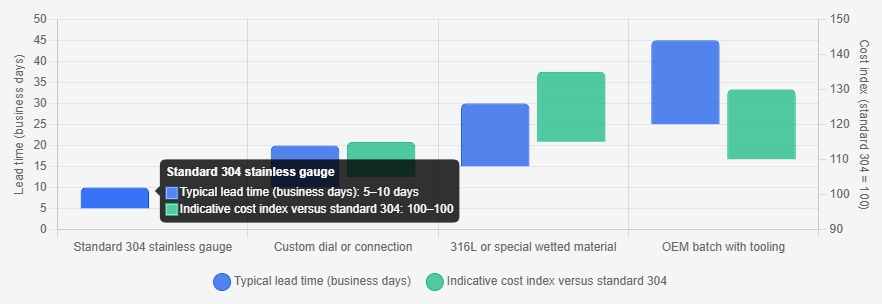
Standard 304 stainless-steel gauges usually offer the shortest lead times and lowest cost. Custom dials, special wetted materials such as 316L stainless steel, and OEM production typically increase both cost and delivery time. Ask each manufacturer to confirm material certificates, accuracy class, customization details, quantity-based pricing, inspection documents, and the committed shipping date.
How to Assess Supplier Reliability, Communication, and After-Sales Support
Choosing a pressure gauge manufacturer in China requires evidence beyond a polished website. The ISO Survey 2022 recorded over 1.2 million ISO 9001 certificates worldwide, but certification alone cannot prove daily reliability. Ask for recent audit records, production capacity, nonconformance rates, and calibration traceability. Each gauge should have a serial number, test result, and clear accuracy statement. Request samples from different production batches. One sample can mislead.
Communication is equally practical. Send the supplier a pressure range, connection type, media, temperature, accuracy class, and delivery target. Reliable engineers should confirm assumptions before quoting. Measure response time, technical clarity, and revision control during this exchange. The World Bank’s 2023 Logistics Performance Index assessed 139 economies and included customs, infrastructure, and shipment timeliness. Use these factors when checking the supplier’s export experience and promised lead times. A spreadsheet showing monthly on-time delivery is more useful than vague assurances.
After-sales support should be written into the purchase agreement. Confirm warranty duration, replacement procedures, calibration services, and response times for failed instruments. Ask whether troubleshooting can include photographs, test reports, and remote technical guidance. Keep a small batch for incoming inspection. I once treated fast replies as proof of service quality; that was careless. The supplier later answered quickly but offered no practical failure analysis. This weakness deserves attention. Good support leaves a documented trail, not just friendly messages.
Digital Tire Pressure Gauge with Hose and Chuck: A Practical Guide to Accurate 0–230 PSI Tire Checks
Digital Tire Pressure Gauge with Hose and Chuck Tire Pressure Monitor ABS Material 0-230psi Range
A digital tire pressure gauge with a hose and chuck makes accurate 0–230 PSI tire checks straightforward for everyday drivers, workshop users, and equipment operators. Its clear digital display provides precise readings, helping users compare tire pressure with the recommended level before driving or operating machinery. The attached hose and chuck make it easier to reach valve stems, while the ergonomic design supports comfortable handling during routine inspections.Designed for convenience, the gauge includes automatic shut-off and a fast-inflate function, allowing users to check and adjust pressure efficiently without relying on manual cranking. Battery-powered operation keeps the tool simple to use, even for people with limited technical experience. Constructed from durable ABS material, it is suitable for regular use in demanding environments. Its broad compatibility with different air products makes it useful for cars, utility vehicles, trailers, and other equipment, including vehicles from the 1983–1991 model years. The combination of a practical hose, secure chuck, responsive controls, and wide pressure range helps users manage tire maintenance with greater confidence.
Conclusion
Choosing the best Pressure Gauge manufacturer in China requires more than comparing prices. First, define your application requirements, including pressure range, accuracy, dial size, connection type, temperature conditions, media compatibility, and installation environment. These specifications help ensure the gauge will perform safely and reliably. Next, evaluate each manufacturer’s production capabilities, engineering experience, testing procedures, material options, customization services, and ability to provide consistent quality for both standard and special designs.You should also verify relevant quality management systems, product certifications, inspection records, and traceability procedures. Compare materials, customization flexibility, minimum order quantities, pricing, production capacity, and lead times rather than focusing only on the lowest quotation. Finally, assess the supplier’s communication, documentation, sample approval process, warranty terms, spare parts support, and after-sales service. A reliable manufacturer should respond clearly, identify potential technical issues early, maintain stable delivery performance, and support you throughout product use. A structured evaluation will help you select a dependable long-term partner.
About Us
Zhuhai Seapeng Automobile Testing Equipment Co., Ltd., a national high-tech enterprise, has maintained a leading position in the manufacturing of tire inflators and tire pressure gauges for nearly 20 years.
Media Contact
Company Name: Seapeng Automobile Testing Equipment Co., Ltd.
Contact Person: Media Relations
Email: Send Email
Country: China
Website: https://www.gdseapeng.com/


